Wednesday, July 12, 2017

"How to Spot Fake Quotes on the Internet"- Abraham Lincoln

There's hardly any doubt now that fake news is a big problem (not to mention determining just what is fake news). However, that's not the only thing catching fire on social media nowadays. Fake quotes are a big problem too. As I've witnessed firsthand, quotes either falsely attributed to historical personages or taken out of context have officially reached meme status long ago. 

Case in point: I remember several years ago a distant aunt of mine shared a picture of Abraham Lincoln on Facebook with a quote:
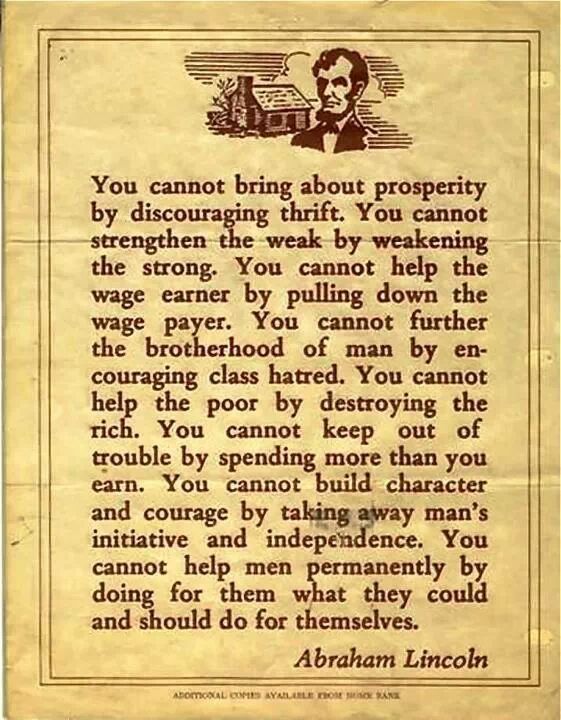

Image result for lincoln you cannot bring about prosperity

Stunned at first, I soon smelled a rat. I'm somewhat of a fan of Abraham Lincoln, and though he definitely said and wrote a lot, I had never heard this before. In fact, such an overemphasis on libertarian-capitalism seemed out of character for Lincoln, considering his unprecedented expansion of government power to free slaves. That was strike one. And let's not forget that Lincoln was one of the greatest orators in American history. So if he was going to say something like this, he would probably would have found a more rhetorically effective way to do so other than cataloging. That's strike two. Finally (and appropriately) I did some quick googling and voilá: FAKE! In fact, the quote is actually from the pamphlet of a conservative German-American Presbyterian Minister, published over fifty years after Lincoln's death. Even now, I'm annoyed with my aunt sharing such a ridiculous falsehood.

While there are plenty of relatively benign cases where an inspirational quote turns out to be inaccurate, this issue shouldn't be underestimated. Anyone with an agenda can potentially appropriate a historical figure to justify their views, and make people believe those figures stood for something completely different than they did. This goes back to one of my earliest posts about using history to justify the present, often falsely. Whether it's gun owners believing Ghandi opposed gun control or video-gamers thinking that Stalin was self-aware, this proliferation of fake-quotes not only influences today's politics and culture but can change the perception of history itself. In the long-run, that's just as dangerous as fake news, if not more.

So to summarize, how to spot fake quotes online:

  1. Go with your gut. If at any point someone is sharing a quote to justify one of their viewpoints or argue for it better than they could, your BS alarm should be active. While it may be tempting to take a shortcut and assume that previously unheard of quotes from famous people are fake, you shouldn't: many "well-known" quotes are often inaccurate too. To be honest, it might be best to just take every quote shared from a historical figure on social media with a grain of salt at least at first.                                                                                                                                  
  2. Context, context, context. Even if they don't mention Twitter or tacos, someone living 500 years ago wouldn't use the same vernacular we do, especially if they spoke another language. Try to find clues in the "quote" that give the real author away.                                                                  
  3. The most important step of all: fact check. Snopes is an excellent site that shuts down fake news and memes circulating on the internet. However, a simple Google search will do provided you do it right. I have to stress here that if you really want to get to the bottom of the story, go down the page: often the first few lines of a unspecified Google search either won't help you or confuse you more. It will take thirty seconds to a minute longer, but trust me, the research you do will be worth it to get to the truth. 
Happy hunting of fake memes my friends. Before I part, I'll leave you with some wise words from one of our Founding Fathers: 

Image may contain: 1 person

Tuesday, July 11, 2017

A Marriage of Convenience?

Sometimes you have to just call things as you see them, and Nicholas Kristof does just that. In a recent blog post, the New York Times contributor offered his "takeaways" regarding Donald Trump and Russian President Vladimir Putin's highly anticipated first face-to-face meeting. Some would hardly surprise you—it is titled "Did Putin Have Trump for Lunch?" after all. Still, Kristof's commentary was concise and precise, and helped contextualize the G-20 summit as well as the impact that Trump and Putin, both separately and together are having on the world.

Kristof asserts that it is absurd for Trump to accept Russia's account on interference in the 2016 election over our own intelligence agencies, none of which, despite what the President says, are in dispute of Russia's efforts. It's also very disconcerting that Trump's attack on the news media (and bullying of our allies) seems to be one of his priorities, so it's altogether fitting for him to stand shoulder-to-shoulder with the leader of a country that saw 58 journalists murdered and regularly defies the international community. Kristof goes on to elaborate his worries about the American withdrawal from the global stage and the dangers of Russia or China filling in the vacuum over, say, the European Union. There's also a significant danger that as the investigation of the Trump/Russia collusion continues, what little credibility Trump still has will dry up and he will become even more erratic. This could lead to wild cards like North Korea or Venezuela taking risks and provoking a disproportionate response. Kristof convincingly argues that our foreign policy is rapidly flipping upside-down.

However, I think that Trump and Putin's meeting planted the seeds (or showed existing ones) of a potential conflict in the future, one that Kristof did not touch upon: Trump vs. Putin. It sounds ridiculous even by today's standards for what passes as possibility, but hear me out. I think we can all agree that both Trump and Putin are two of the most prominent opportunists in the world. Ever since the fall of the Berlin Wall, whether as KGB head, Prime Minister, or President, Putin has done nearly everything in his power (and some things arguably beyond) to push back against Western political and economic influence. Despite these acts prompting international backlash against Russia and claims that Putin could push his luck for only so long, he's been thriving. Enter Trump, an equally opportunistic man willing to challenge anyone who stands in his way and fan the populist flames that had been spreading across America even before 2016 by promising to "clear the swamp" of American politics. Trump's motivations seem much less clear than Putin's (unless it really is just something like pungent narcissism) but is just as strong, if not more.


 Image result for shaking hands double cross


Why wouldn't these two make a marriage of convenience? It's not like there's no history of it ever happening in Russia. Just in the last century alone, Russia signed two deals with their devils at the time. The first came in 1894 with the Franco-Russian alliance, then in an expansion in 1907 with Britain, later known as the Triple Entente. Though meant to counteract the rise of Germany, an alliance between two democratic and liberal countries and such a backwards and authoritarian one like Russia proved to be embarrassing to all parties. Its much more notorious sequel came in 1939 with the Molotov–Ribbentrop Pact, a non-aggression pact between a fascist Germany and a communist Russia, which by anyone's account should be natural enemies (as they soon proved to be). Hitler proposed it to cover his back for when he went to war with Western Europe later, Stalin did so in order to gobble up Eastern territory. Such cynically opportunistic act from both nations shocked the world. So why wouldn't Russia, who's been on the losing end on the global stage even before 1989 be willing to try it again?

The problem with these sorts of arrangements is that they rarely last because they stand on such shaky ground between untrustworthy parties. While it's absolutely not certain to happen, I believe it is possible that there will come a time when Trump and Putin will turn against each other. Maybe it will be over Russian intransigence in Syria, or a trade deal gone wrong, or one or the other finally overplay their hand. While we shouldn't be afraid of this yet, since there's so many other pressing concerns at this time, I think it would be prudent to keep such a possibility in the back of our minds. Because as many of us know, conflicts stemming from friends-turned-enemies are not pretty.

Saturday, July 8, 2017

Wikipedia Listened!

Some time ago, I decided to update a Wikipedia entry on George Orwell's Homage to Catalonia. I felt that even in terms of Wikipedia's usual bare-bone summary, it was still leaving out important information about Orwell's personal character during his time in Spain. The addition of mine that modified the entry most pertained to how upset Orwell was at not being able to capture an enemy telescope, despite securing a number of weapons. It being Wikipedia, I figured my entry wouldn't last long despite my citations.

However, on my most recent visit to the page, my entry remained untouched! So either my insight was so valuable no one thought they should touch it or else I'm the only person visiting this page. Either way, I consider this a victory. George Orwell can rest easy knowing that I understand his dismay at not being able to get his telescope!

Thursday, July 6, 2017

The "Gift" No One Wants: The Situation in North Korea

Several weeks ago, in response to the latest rounds of North Korean provocations, I reviewed the US's role in the Korean War and expressed my opinion as to whether it was worth it for us getting involved. While I believe it was worth it, it's becoming increasingly clear each month that the work there remains unfinished. In fact, things are becoming downright grim, and honestly for me it's the scariest thing happening in the world right now. 

A review of what's happened this time.

First, there's the tragic death of Otto Warmbier. The American student was sentenced to 15 years of hard labor by the regime last year for trying to steal a propaganda poster while he was in the country with a tour group. During that time he was tortured so badly that he fell into a coma. Perhaps because of this the regime decided they had nothing worth losing and released Warmbier to the US. He died on June 19th, six days after he was returned home. There are still Americans imprisoned in North Korea. 

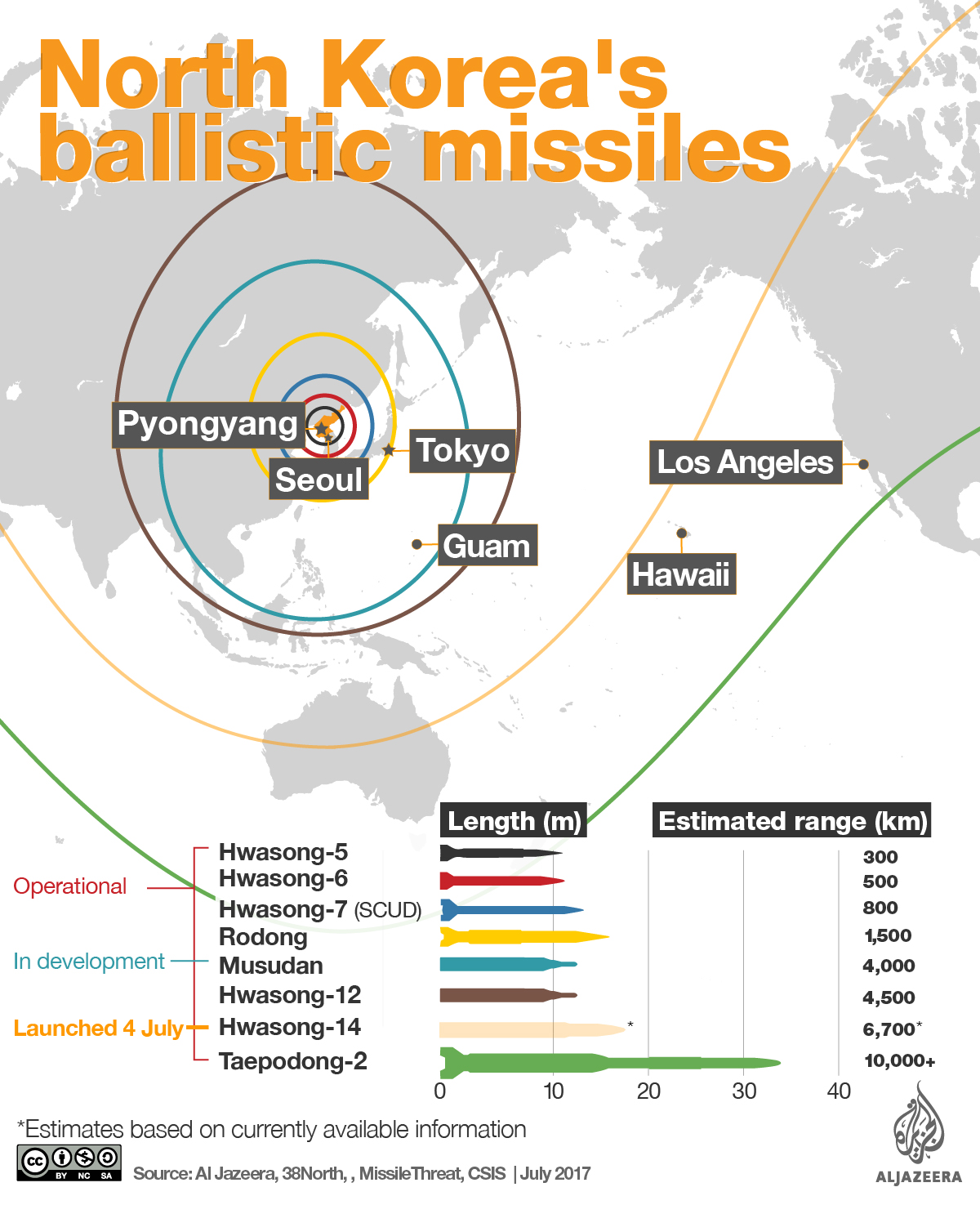
Then on July 4th (as a "gift package" to the US on its national anniversary), North Korea successfully tested an Intercontinental Ballistic Missile, the Hwasong-14 that appeared to be capable of hitting Alaska or Hawaii, certainly in range of Seoul or Tokyo. While it's unclear if a nuclear warhead could be attached to the missile, even if North Korea can't now it will be able to soon. This sharply escalated the tensions in the region, and tempers are rising among all parties. (Note: As shown in the graphic below, while the Taepodong-2 appears to have greater range, its test didn't appear as promising as the most recent missile's.) 


So what's the way forward? Right off the bat, no one wants to risk war. Even "surgical" strikes to take out North Korean weapon facilities and launch sites are almost certain to trigger a full scale war in the region, maybe even to nuclear levels. Regardless of political affiliation, even the most ardent hawks are reluctant to risk sparking a full scale war on the Korean peninsula. So that's out.

China, usually seen as the only source of leverage to North Korea, has not been able to make a dent and they probably won't now. Their biggest concern isn't a nuclear-armed regime but the country destabilizing and potentially collapsing, which would flood China with refugees and put an American military base on their border. President Trump has already demonstrated his annoyance with China by selling arms to its rival Taiwan, sanctioning one of its banks, and sending a destroyer to the South China Sea. But frankly the US doing this is only cutting off their nose to spite their faces, even beyond North Korea. The last thing we would want is poor relations with our biggest trading partner, especially considering that they're gearing up to fill the role the US seems to be withdrawing from on the world stage. However, the fact remains that they're not much help on North Korea anymore. 

Diplomacy remains the most viable option. Specifically, the US should try to replicate what the Clinton Administration brokered in the 1990s. This deal eased sanctions and lowered the rate of military exercises in exchange for the North Koreans freezing their weapons program. The deal certainly wasn't perfect, as North Korea snuck in uranium tests on the side, but for the duration of Clinton's presidency, no nuclear warheads were developed by the regime. Even if a similar agreement goes forward, it certainly won't solve the North Korean problem; it essentially would only kick the can down the road for who knows how long. North Korea also just isn't going to give up their nuclear arms, as they see it as their only means of survival, but they might not take it any further for the sake of stabilization in the region. Everyone seems to agree that this is the least bad option out of all the others. 

Though it's a deal with the devil, such an option should be pursued to the fullest degree. War would be catastrophic, and must be avoided. Let's hope the world's leaders understand that. 


Wednesday, July 5, 2017

Robert E. Lee Never Deserved Your Respect

I recently posted about the anniversary of the Battle of Gettysburg, and I found that I still had more to say that directly related to current events. The very reason I started this blog was in response to the growing calls for the removal of Confederate monuments in the South, and the frankly amazing fact that many were indeed taken down. None mattered more symbolically than the statue of General Robert E. Lee in New Orleans. His monument was one of the most hotly contested, and was subsequently the most satisfying of the removals when he was finally lowered from his pedestal, literally and figuratively. It really was a remarkable occasion, made more so by Mayor Mitch Landrieu's moving speech about the historical significance of the event; it's a major step forward to right the wrongs of the past.

I wish I could have been there, because years before the widespread calls for Confederate monument removals, Robert E. Lee was on my $#%& list. Unlike many other Civil War historians, even out of the ones that have no qualms labeling the Confederacy for what it was— an Empire of Slavery— there still remains a professional and personal admiration for Lee. They cite the integrity and pride of his Christian character and his brilliant tactics on the battlefield as justifications for their respect. Even as a kid, I never bought it. In fact, I remember on my tour of the Capitol Building shouting in offense at seeing a statue of Lee (in his rebel uniform no less!) sitting at a prominent spot in one of the halls. True, he was no John C. Calhoun or Nathaniel Bedford Forrest, but despite setting the bar so low, I never believed that somehow Lee was some sort of good guy in a terrible system.

I didn't know how right I was.

Image may contain: 5 people
Credit to the author for this one (FYI Lee is on the left, Ulysses S. Grant is on the right)

In an outstanding and personally vindictive piece for the Atlantic, Adam Serwer exposes Lee for the man he really was, what he stood for, and how much damage he did. His popular image is mostly fiction, generally maximizing his good traits and minimizing his bad ones, but also, in Mitch Landieu's words, propels "lies by omission" by his defenders for over 150 years. Here are a few highlights:


  • Before anything else should come the evaluation of Lee through a military perspective. While he is rightly considered to be a master tactician, his strategic decision to wage a conventional war against the industrial-powered North was a disastrous move that escalated the war and brought death and destruction to the South. Even tactically, he was still capable of colossal mistakes. His stubbornness at Gettysburg, namely Pickett's Charge lost him the battle and set the stage for the collapse of the Confederacy.
  • Though not a rabid slave-owner, Lee was anything but benevolent. He was still by all means a white supremacist who paternalistically saw slavery as good for black people, and only Christ could free them. He split slave families and oversaw or personally beat slaves who tried to escape. 
  • His army enslaved free blacks and executed captured black Union soldiers. He refused to conduct a prisoner exchange with Union General Ulysses S. Grant if black soldiers were on the table, despite his dire shortage of troops. 
  • The one aspect of Lee I previously respected was the dignified surrender of his army to General Grant. This in effect prevented a Southern insurgency from spawning and contributed to the reunification of nation. Now I have none. After Appomattox Court House, Grant felt his former rival fell short in trying to sow seeds of peace, and saw Lee's conduct as a "forced acquiescence." This helped give way to the Lost Cause myth which was the foundation of Jim Crow. 
  • Even as president of Washington College, Lee oversaw a chapter of the KKK formed at the university and turned the other way when white students committed crimes against blacks in the area, including several lynchings. Though he never formally endorsed the KKK, he never spoke against it either, and there's good evidence to suggest he tacitly approved of it by suggesting the South could give way to violence if it did not name the peace terms. 
As Serwer notes, the only fitting monument to Lee is the Arlington national military cemetery that's on his former land, which the federal government had seized. White supremacists are the only ones that have reason to admire him. That makes him nothing more than a disgrace to America and its history. Hopefully now his myth will finally start to die and the truth will come to stand in his place. 

Monday, July 3, 2017

Down and Dirty at Gettysburg


Today, July 3rd, is the anniversary of the Union victory at Gettysburg in 1863. While I'm basking in our victory against the rebels (both then and now), I thought I'd share with all of you my favorite film depiction of not just Gettysburg but of the entire Civil War. It's from a History Channel special from several years ago, and with great respect to the 1990s movie of the same title, I think it embraces realities of the war that the movie chose to sanitize. Yes, it's also dramatized, but to me it's effectively the Saving Private Ryan of the Civil War, in that it tells the stories of those on all sides of the battle while getting down and dirty in the trenches. If you're only going to watch one part of it, watch this one.


Go on, try to tell me you don't have your hair standing on the back of your neck. Tell me that seeing the Iron Brigade completely own the rebels doesn't make you wish you could jump in and help them. Tell me that as you watch it you're not both in awe of the courage and commitment of the soldiers while also repelled that so many would fight for something so terrible. Finally, tell me that you never realized that we could have lost it all, if not at Gettysburg than somewhere else. Sometimes it's incredibly difficult to comprehend. But if you can get close, then you can see that the Civil War was unlike any other war in American history before or since. 

So happy Victory Day, on July 3rd and July 4th!

Saturday, July 1, 2017

What People Think I Do: Historian Edition

In a few previous posts, I talked a lot about the work that historians do and what I appreciate about studying history. However, while historians all take their work seriously, I don't believe it's the same for themselves personally (except for a few terrible people). With that attitude in mind, for this post I thought I'd do my best to qualify a classic meme's perception of historians:


  • What my friends think I do
    • This image is accurate enough. From the feedback I get from my friends, being a history major/historian doesn't capture the imagination quite as much as a lot of other fields of work. It should be noted though that when I'm researching or writing I often have multiple tabs YouTube videos ready to play at a moment's notice for no reason other than my own entertainment. Oh, I have sources too!
  • What my mom thinks I do
    • My mom was an English major, and being cooped up in a library is an experience I shared with her. It's really impossible not to spend extensive time in a library even in the digital age, especially for students, given the necessity for primary sources and the fact that libraries are free. For my last research paper on Thomas More, I needed at least 7 books published early in the last century, which required much searching, begging librarians for help, and sifting through mountains of paper. You will become trapped in a dark recess of the library forever if you're not careful.
  • What society thinks I do
    • Along with being jobless and usually ignored, re-enacting battles seems pretty accurate for the public's perception of historians. However, make no mistake: those guys are passionate about what they do. They have to provide their own equipment, donate tons of their spare time to learn how to "fight," and they know the details of the battle, the time, and the actual person they're playing like the back of their hand. Their hobby helps make sure society doesn't forget these battles and their consequences. Also, according to my friend who's a Revolutionary War re-enactor, they're great at partying too. Make no mistake though,  some re-enactors can take it a bit too seriously, or worse, do it for the wrong reasons altogether. 
  • What the university thinks I do
    • This is definitely true, but if any of my history classes had as many people as there are in this picture, we would have a lot more classes to choose from, not to mention more clout with the Dean. 
  • What I think I do
    • I do certainly hope that if you read my blog, or God forbid actually know me personally that I help you learn a bit more about history and its importance. Personally, I do feel  that I'm almost like an architect walking through a city whenever I watch the news or learn about a particular period––I know (generally) how it all got here. 
  • What I actually do
    • History-related or not, at any given time in my room at home or my dorm, this is what it looks like. Enough said.