Showing posts with label Image. Show all posts

Monday, July 24, 2017

Fake Quote Found!

Believe me, I didn't plan this.

In a recent post, I discussed the perpetuation of fake quotes from historical figures on social media and how to spot them. To summarize, in my opinion the problem stands to be just as serious as fake news in the long run. Though there are plenty of cases of people mistakenly sharing fake quotes that are mostly benign, there are plenty of others who do it on purpose. The goal of these sharers is to appropriate an historical figure so they can justify their own point of view in the present, often distorting the figure and what they stood for. 

Enter Anthony Scaramucci.

For those who don't know, Scaramucci is the White House's new Communications Director. The appointment was so controversial that it caused the White House Press Secretary Sean Spicer to resign, effectively ending one of the best SNL segments in years. His anger can be understandable, considering that Scaramucci, a Wall Street financier, doesn't seem to have much experience in the role he was given. Moreover though, perhaps Spicer's real beef with him was the fact that Scaramucci was once a Trump-basher who apparently decided to let bygones be bygones when opportunity knocked. Just another day in the Trump White House.

But the real story here has to do with Scaramucci's Twitter account. He's been trying and mostly failing to delete tweets that were critical of Trump and expressed views that were contrary to his. Though non-political, one that popped up and has not been deleted was this one: 


You already know where this is going, right? Yup, fake. Mark Twain never said that. I mean I was expecting to find a fake quote at some point after my post about it but come on! 

Should it be disconcerting that the Communications Director of the White House, whose job it is to be the conduit between the President and the press (and by extension the country), didn't bother to check his sources before he shared a quote he liked? You decide. 

Remember friends, BS is everywhere. Keep your eyes open for it, always. 

Sunday, July 23, 2017

Stepping Onto Normandy Beach


By now it was late afternoon. The cool fog that had proliferated since the early morning had almost completely burned off, and the sun glistened in the sky. Normally after so much travelling I’d start to get tired, but I left plenty in my reserve specially for the last section of the tour. I was softly excited, but a bit uneasy. I wasn’t sure what to expect, not from the place but from myself.

The van stopped, and my French tour guide and the three other passengers got out. We walked twenty yards to a road parallel to the sea. Then I finally saw it with my own eyes.

Omaha Beach.


Last semester I had the opportunity to study abroad in London. For my spring break (don’t worry, I did other stuff too) I got to finally to visit the number one place I always wanted to go to as a history buff: Normandy beach. I booked a tour in Bayeux, France, of the American sector of the D-Day landings from June 6, 1944. My only regret from the entire trip was that I didn’t spend more time there and visit the British and Canadian sectors as well.

It was a historian’s dream, and the experiences I had earlier that day already left me awestruck. I had been into the church of St. Mere-Eglise where the 82nd Airborne landed, Utah beach where my great-uncle landed 73 years ago, and the Point du Hoc where the US Army Rangers scaled the cliffs in order to destroy German heavy guns, to name a few. But I couldn’t really believe I had been to Normandy without visiting one of the most enduring and visceral symbol of the entire war, let alone the landings themselves. Now I was finally here.

Where I stood, there was a German bunker and war memorial to my left. To my immediate right was a road stretching behind the beach with a bluff and several houses laid out behind it. And in front of me was the beach. The first thing that strikes you about it is its sheer vastness. It’s both incredibly deep and wide, with the waves breaking off so far that there are hardly any tide pools at all. However, the water clearly washed up very close to shore, on account of the smoothness of the sand.

After a few words and some more gazing, heart pumping I finally stepped onto the beach. Perfect footprints were left in the sand and not a grain of it ended up in my shoes. Our tour guide led us to the middle of the beach about fifty yards in. For the next fifteen minutes, the tour guide shared more details and period photos of the invasion. With each minute I was able to imagine myself even more vividly in an American soldier’s shoes. It was astounding and spine-chilling.

Imagine you’re where I am, which would be closer to the cliffs than where the first soldiers landed. You would be knee-deep in water, weighed down by loads of equipment. Ahead of you are mines, anti-tank emplacements, and barbed wire. Each minute, more and more Germans are pouring machine gun fire straight on you from the bunkers ahead. And perhaps worst of all is the sheer distance you have to go—hundreds of yards ahead of you into the fire. If you can't imagine it, maybe this will help. I could not stop thinking about how $%&*#@ I would have been.


As I turned and looked out towards the sea and thought about the countless lives’ lost on this beach. Prior to arriving, I figured if there was going to be a single time I would straight-up break down and cry it would be now. But what I was going through instead surprised me. I can’t quite explain it, perhaps it was mindfulness or just an enormous sense of gravity. I would describe it like as if you were standing at the top of a mountain and looking upon the world below. You can’t judge it or connect it to anything or really think about it at all very much. All you can do is just take it all in.

The next thing I did surprised me even more. I took several steps away from my group. I remembered I had a zip lock bag in my pack. Without thinking I reached down and grabbed a handful of sand, and then another and another. The sand was golden brown and seemed to have broken shells in it, wet from the sea. I closed the bag, put in in my pack, then walked off the beach, catching up to my tour guide.


We still did other things for the tour, including visiting the gorgeous American cemetery just behind the beach. That was incredible too, but nothing I did after—or really, ever—will compare to stepping on Omaha beach myself that day and seeing it with my own eyes. That sand sits in the bag on my bookshelf, still wet with the water from the English Channel. It's a reminder to me of what I experienced that day and what those men did for you and me all those years ago. I will never remove it. 

Wednesday, July 5, 2017

Robert E. Lee Never Deserved Your Respect

I recently posted about the anniversary of the Battle of Gettysburg, and I found that I still had more to say that directly related to current events. The very reason I started this blog was in response to the growing calls for the removal of Confederate monuments in the South, and the frankly amazing fact that many were indeed taken down. None mattered more symbolically than the statue of General Robert E. Lee in New Orleans. His monument was one of the most hotly contested, and was subsequently the most satisfying of the removals when he was finally lowered from his pedestal, literally and figuratively. It really was a remarkable occasion, made more so by Mayor Mitch Landrieu's moving speech about the historical significance of the event; it's a major step forward to right the wrongs of the past.

I wish I could have been there, because years before the widespread calls for Confederate monument removals, Robert E. Lee was on my $#%& list. Unlike many other Civil War historians, even out of the ones that have no qualms labeling the Confederacy for what it was— an Empire of Slavery— there still remains a professional and personal admiration for Lee. They cite the integrity and pride of his Christian character and his brilliant tactics on the battlefield as justifications for their respect. Even as a kid, I never bought it. In fact, I remember on my tour of the Capitol Building shouting in offense at seeing a statue of Lee (in his rebel uniform no less!) sitting at a prominent spot in one of the halls. True, he was no John C. Calhoun or Nathaniel Bedford Forrest, but despite setting the bar so low, I never believed that somehow Lee was some sort of good guy in a terrible system.

I didn't know how right I was.

Image may contain: 5 people
Credit to the author for this one (FYI Lee is on the left, Ulysses S. Grant is on the right)

In an outstanding and personally vindictive piece for the Atlantic, Adam Serwer exposes Lee for the man he really was, what he stood for, and how much damage he did. His popular image is mostly fiction, generally maximizing his good traits and minimizing his bad ones, but also, in Mitch Landieu's words, propels "lies by omission" by his defenders for over 150 years. Here are a few highlights:


  • Before anything else should come the evaluation of Lee through a military perspective. While he is rightly considered to be a master tactician, his strategic decision to wage a conventional war against the industrial-powered North was a disastrous move that escalated the war and brought death and destruction to the South. Even tactically, he was still capable of colossal mistakes. His stubbornness at Gettysburg, namely Pickett's Charge lost him the battle and set the stage for the collapse of the Confederacy.
  • Though not a rabid slave-owner, Lee was anything but benevolent. He was still by all means a white supremacist who paternalistically saw slavery as good for black people, and only Christ could free them. He split slave families and oversaw or personally beat slaves who tried to escape. 
  • His army enslaved free blacks and executed captured black Union soldiers. He refused to conduct a prisoner exchange with Union General Ulysses S. Grant if black soldiers were on the table, despite his dire shortage of troops. 
  • The one aspect of Lee I previously respected was the dignified surrender of his army to General Grant. This in effect prevented a Southern insurgency from spawning and contributed to the reunification of nation. Now I have none. After Appomattox Court House, Grant felt his former rival fell short in trying to sow seeds of peace, and saw Lee's conduct as a "forced acquiescence." This helped give way to the Lost Cause myth which was the foundation of Jim Crow. 
  • Even as president of Washington College, Lee oversaw a chapter of the KKK formed at the university and turned the other way when white students committed crimes against blacks in the area, including several lynchings. Though he never formally endorsed the KKK, he never spoke against it either, and there's good evidence to suggest he tacitly approved of it by suggesting the South could give way to violence if it did not name the peace terms. 
As Serwer notes, the only fitting monument to Lee is the Arlington national military cemetery that's on his former land, which the federal government had seized. White supremacists are the only ones that have reason to admire him. That makes him nothing more than a disgrace to America and its history. Hopefully now his myth will finally start to die and the truth will come to stand in his place. 

Saturday, July 1, 2017

What People Think I Do: Historian Edition

In a few previous posts, I talked a lot about the work that historians do and what I appreciate about studying history. However, while historians all take their work seriously, I don't believe it's the same for themselves personally (except for a few terrible people). With that attitude in mind, for this post I thought I'd do my best to qualify a classic meme's perception of historians:


  • What my friends think I do
    • This image is accurate enough. From the feedback I get from my friends, being a history major/historian doesn't capture the imagination quite as much as a lot of other fields of work. It should be noted though that when I'm researching or writing I often have multiple tabs YouTube videos ready to play at a moment's notice for no reason other than my own entertainment. Oh, I have sources too!
  • What my mom thinks I do
    • My mom was an English major, and being cooped up in a library is an experience I shared with her. It's really impossible not to spend extensive time in a library even in the digital age, especially for students, given the necessity for primary sources and the fact that libraries are free. For my last research paper on Thomas More, I needed at least 7 books published early in the last century, which required much searching, begging librarians for help, and sifting through mountains of paper. You will become trapped in a dark recess of the library forever if you're not careful.
  • What society thinks I do
    • Along with being jobless and usually ignored, re-enacting battles seems pretty accurate for the public's perception of historians. However, make no mistake: those guys are passionate about what they do. They have to provide their own equipment, donate tons of their spare time to learn how to "fight," and they know the details of the battle, the time, and the actual person they're playing like the back of their hand. Their hobby helps make sure society doesn't forget these battles and their consequences. Also, according to my friend who's a Revolutionary War re-enactor, they're great at partying too. Make no mistake though,  some re-enactors can take it a bit too seriously, or worse, do it for the wrong reasons altogether. 
  • What the university thinks I do
    • This is definitely true, but if any of my history classes had as many people as there are in this picture, we would have a lot more classes to choose from, not to mention more clout with the Dean. 
  • What I think I do
    • I do certainly hope that if you read my blog, or God forbid actually know me personally that I help you learn a bit more about history and its importance. Personally, I do feel  that I'm almost like an architect walking through a city whenever I watch the news or learn about a particular period––I know (generally) how it all got here. 
  • What I actually do
    • History-related or not, at any given time in my room at home or my dorm, this is what it looks like. Enough said. 


Monday, June 26, 2017

How Bills Got Passed: President Lyndon B. Johnson and His Treatment


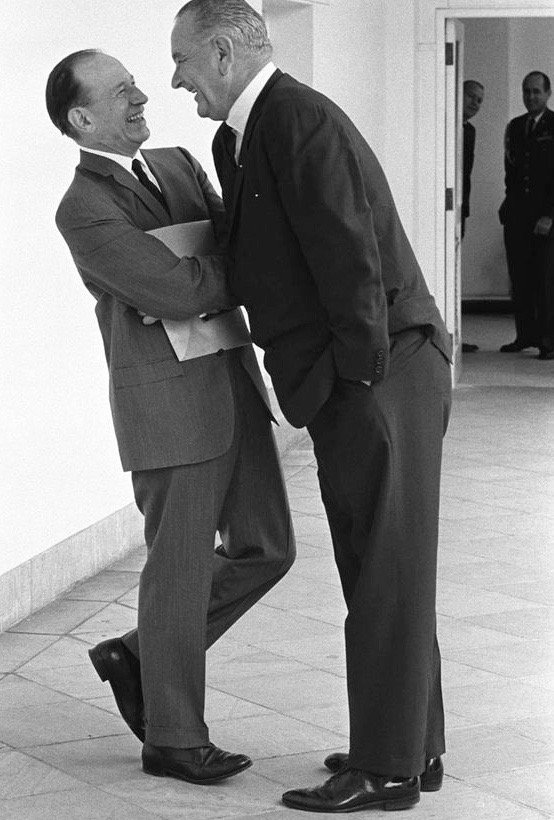
Former FBI Head James Comey expressed in his testimony to the Senate that the reason he kept notes of his meetings with Donald Trump and circulated them as memos was because he was very uncomfortable being left alone in a room with him. Now, that feeling is more than understandable, but politics aside, it's worth noting that Trump isn't the first man in the White House to intimidate the bejesus out of others. Andrew Jackson might take the prize, seeing that it was well known that prior to his presidency he had killed quite a few people (and as president beat up one would-be assassin), so that certainly was on his visitors' minds. However, the true champion of Scrubs-style tear inducing has to go to President Lyndon B. Johnson. The direct threat of violence was unnecessary for the greatest nightmare to haphephobics ever to take office, and in fact probably made the idea of dying seem like sweet relief to his victims. Johnson wasn't known as the Master of the Senate or able to get Civil Rights and Great Society bills to his desk by being a nice pencil-pusher. He used his God-given size, strength, and drive to make goal-based intimidation an art: The Johnson Treatment. Let's analyze one notable case here:


Image result for lbj and abe fortas

It should be pretty obvious who Johnson is in this picture. The other one though is Abe Fortas, not only Johnson's own Supreme Court appointee but also a longtime supporter of his. So this is Johnson parodying his own treatment. Still, Fortas doesn't seem to be at his best here. Let's go over the Johnson Treatment in detail:


Two witnesses looking like they just managed to snag tickets to the last gladiator match of the season. Except Fortas is the doomed gladiator and Johnson is the lion about to rip him to shreds. Note the safe distance the men are at, knowing very well they could be next.


Though both men appear to be sharing a laugh, it comes from opposite ends. Johnson is almost certainly roaring with laughter at one of his own jokes, whereas Fortas is laughing the kind of way horror-movie teenagers do between hopelessly concealing their fear at their current situation and getting axed. Note how Johnson is using his height to stare directly into his eyes from above like a fighter jet about to do a strafing run.


I don't know what Fortas is clutching here but he seems to be holding onto it for dear life, like it were a life jacket or a pitiful shield. Note the continuous decline of Fortas's back and how Johnson's abdomen is still parallel to his head and neck, like an industrial crane lowering steel.


I definitely don't think that this detail has to do with this picture, but it's impossible to paint an accurate picture of Johnson, let alone his Treatment without bringing up this aspect of him. I'll let the link do the talking. (PG-13 content ahead)


Finally, my favorite part of this photo. Whereas Johnson's right leg is planted like a Redwood and his left leg is barely leaning forward at all, not only does Fortas's left leg seem like it's trying to nonchalantly escape and leave the rest of his body behind, but his right heel is barely able to balance his falling body. In fact, it appears that if Fortas is forced backward one more inch, he'll just straight-up run away from the White House altogether, which Johnson knows, so instead of crossing the line he just keeps stomping his foot on it.

And this picture is just one aspect of the Johnson Treatment. There were loads of other methods Johnson incorporated into his treatment, whether it was driving his car into his ranch's lake (without letting his passengers know the car doubled as a boat) or making his aides follow him into the bathroom. Remember, however, that like a martial arts master, Johnson did his best to use his Treatment for good. Without it, his Great Society, Medicare, Medicaid, and Civil Rights Acts would likely never have happened. And he did it all without Twitter, for one, and knew exactly what he was doing. Domestically, anyway.


Monday, June 19, 2017

George Orwell is STILL Upset About Some Things...


We all know and love Wikipedia. It remains one of the most extensive, user-friendly databases on the internet, and is the go-to place for anyone looking for basic summaries for almost any subject. It's so ubiquitous that I remember the shift that occurred in high school on Wikipedia policy. After years of my teachers saying that Wikipedia absolutely could not be used under any circumstances, the administration finally acquiesced, and almost overnight it went from being entirely off-limits to just not being an acceptable source for citation. However, it would still be used "to get the gist" of any given subject, or to find other sources. 

Still, it doesn't mean Wikipedia is without its flaws, even beyond issues of citation and accuracy (though to be fair they've improved tremendously in recent years, citing more often and saying upfront when there's not enough sources). My problem with it is that it often leaves the most interesting things out. I know of course Wikipedia is meant to be only summaries of subjects, however I believe they omit facts that are essential to understanding the topic.


George Orwell in Spain, above the man with the machine gun

Take Wikipedia's entry on Homage to Catalonia, by George Orwell. Orwell is one of my absolute favorite authors and 1984 is both my favorite book and probably has had a bigger impact on me than any other before or since. But another one of his best works is his own account of his participation in the Spanish Civil War, fighting on the government's side against German and Italian-backed fascist rebels. It's a remarkable piece about period geopolitics, Spanish culture, and the absurdities of the conduct of this particular war. It provides wonderful insight into Orwell himself, with his dry wit, his sharp commentary, and his willingness fight for and stick with the loyalists even in the face of death or arrest. There's one particular bit in chapter six that provides clues to his character that Wikipedia chose to omit. Here is the original:

Chapter six[edit]One of these operations, which in chapter five had been postponed, was a "holding attack" on Huesca, designed to draw the Fascist troops away from an Anarchist attack on "the Jaca road." It is described herein. Orwell notes the offensive of that night where his group of fifteen captured a Fascist position, but then retreated to their lines with captured rifles and ammunition. The diversion was successful in drawing troops from the Anarchist attack.

Here are my additions:

Chapter six[edit]One of these operations, which in chapter five had been postponed, was a "holding attack" on Huesca, designed to draw the Fascist troops away from an Anarchist attack on "the Jaca road." It is described herein. It is one of the most significant military actions that Orwell participates in in his entire time in Spain. Orwell notes the offensive of that night where his group of fifteen captured a Fascist position, but then retreated to their lines with captured rifles and ammunition. However, despite these finds, Orwell and his group were forced to pull back before they could secure a large telescope they had discovered in a machine gun case, something more badly needed to their side than any single weapon. However, the diversion was successful in drawing troops from the Anarchist attack. The chapter ends with Orwell lamenting that even now he still is upset about losing the telescope.[16]

First, my additions show that Orwell actually saw fairly little fighting against the Fascists by this time, which informs the efforts he makes to join an International Column later in the book. Second, the detail about the telescope helps the reader comprehend the nature of the war and how lo-tech it was for a time. Would you have ever thought that a telescope would be more highly valued than machine guns or rifles in 1937? You would have to go back to before the 20th century for that to be the case. So this war's conduct was quite an anachronism! Finally, the fact that Orwell still goes to pieces about losing the telescope illustrates some of the man himself. He risked life and limb for that telescope and got nothing for it. The telescope mattered so much to him in his entire time in Spain, and he probably felt that its capture would have made a difference in his sector. If you were in his place, would you feel any different? George Orwell, for all his experience and wisdom in a lot of ways is no different from us. The lesson here is that while Wikipedia is a good place to start, you should never stop there. It's just the tip of the iceberg. 


Sunday, June 18, 2017

The Only History Book You'll Ever Need to Read

If I was only ever to do one review of anything for this blog, it would be for The Great Big Book of Horrible Things, by Matthew White. If you seem unsettled, or skeptical with the title, don't; I really don’t think anything else I would potentially recommend would surpass or even equal the impact that this book would have on you, as it did for me when it was first bought for me as a throwaway Christmas present five years ago.

Neither a macabre coffee table book nor an impossibly dense collection of stats, this book is essentially an editorialized reference book. Now that may seem like a contradiction, and in most cases it would be, along with being not all that interesting. But White, a self-described “numbers freak” with a gift for historical writing masterfully weaves bold classifications with sober analysis and goofy commentary to create an utterly unique work, one that almost seems unrecognizable from others. White's goal in this book is to bring the best justice he can to the countless of overshadowed or altogether forgotten victims in historical killings, and those efforts shine bright. Horrible Things is credited by distinguished psychologist Steven Pinker, who provides the foreword, as the "the most comprehensive, disinterested and statistically nuanced estimates available." Ever since I’ve read it, I’ve tried to emulate White’s approach and style and I’ve proudly cited it multiple times in my own reports.


In assessing history's deadliest man-made events, White, who has no formal training in history or statistics, approaches the subject with a scientific method. He rejects consensuses about the death toll of a given event, instead going straight back to primary and secondary sources. He throws out the highest and lowest numbers and plugs in the median. How does he get these sources, you ask? "The short answer is money," White replies. "Even if a general is reluctant to tell the newspapers how many men he lost in a bungled offensive, he still has to tell the accountants to drop 4,000 men from the payroll... Head counts (and by extension, body counts) are not just an academic exercise; they have been an important part of government financing for centuries." The length of each chapter is proportional to the deadliness of the event.

However, it's not the numbers that are of the most interest in this book, even if it is the selling point. It's how White incorporates them into his writing. Each chapter is categorized rather surprisingly, and loaded with unexpected, juicy terms of White's invention, like 'atrocitology,' 'multicides,' and 'hemoclysm' that capture the reader's imagination much more than dry terms like 'genocide.' His commentary captures the ironies, tragedies, and downright absurdities of history. Here are some examples, starting with his chapter on Timur:

TIMUR
Death toll: 17 million
Rank: 9
Type: world conqueror
Broad dividing line: Timur vs. everyone he could get to
Location: central Asia, the eye of the hurricane being Samarkand
Who usually gets the most blame: Rimur; also called Tamburlaine (old version) or Tamerlane (newer version) from his insulting nickname, Timur Lenk ("the Lame")
Another damn: Mongol invasion

Here's an example of White describing Saladin In his Crusades chapter (3 million deaths):

In reality, Saladin's sense of honor was flexible... []Two leading crusaders were brought to him in chains. He fed the first one, explaining that the rules of hospitality now forbade him from killing a prisoner who had been given food and drink by his captor. Another prisoner... lunged for a cup of wine and downed it before anyone could stop him. [He] thought, Aha! I'm safe! But Saladin killed him anyway because no one likes a smartass.

White understands, however, the issues and contention that really do affect our modern life and knows when to be serious, not tolerating some minority opinions. Believe it or not, there's a sizable minority of people who believe that the Western democracies fought on the wrong side of WWII (along with the faction that denies the Holocaust). White responds with this: 

In this case, revisionists seem to forget the world went to war against Hitler because he was dangerous, not because he was evil. This is an important distinction in international relations. You can do whatever you want inside your own country, but when you start invading your neighbors, the rest of the world gets jumpy. No matter how brutal Stalin may have been to his own people, he was content to stay inside the borders of the Soviet Union. By the time Stalin began grabbing small countries for himself, the West was already committed to war with Hitler. The choice wasn't between fighting Hitler or Stalin. The choice was to fight Hitler or both of them.

Despite his unorthodox form and his use of black humor, it’s understandable to think that reading White’s book about humanity’s worst achievements might get a little depressing after a while. However, with each chapter I absorbed, I got steadily more excited until I felt downright enlightened by the end. This is because what happens as you travel across time and the world in White’s book is that you feel a remarkable sense of discovery. Because of White’s information, style, and arguments, you really do feel that you understand not just history but humanity so much better. White passes the historian’s ultimate test with flying colors and imprints it on the reader: He effectively makes history relevant to the reader, and uses it to better understand our present and prepare for the future. It worked for me and it will surely work for you. 

For more on Matthew White visit his website (don't be fooled, it deliberately looks old-school) or the New York Times review of Horrible Things.

To check out the book itself, click here