Showing posts with label War. Show all posts

Tuesday, August 1, 2017

The Lincolns Live On: Taking the Fight to the Enemy

A very troubling trend that's been occurring for the last several years, and often appears in headlines, are Muslims from the Western world either going to Iraq and Syria to fight for the Islamic State or pledging their allegiance to it and staging domestic terrorist attacks. These people are both teenagers and adults, men and women, and many are citizens of America, the UK, France, etc. It's estimated that well over 27,000 foreigners have traveled to ISIS's  "caliphate" to fight for them, and that study is a year old and doesn't even account for those who pledge their loyalty then stage a terrorist attack at home.


Image result for isis political cartoons 2017


However, while disturbing and dangerous indeed, the good news is that ISIS members are not the only ones fighting not to mention there's plenty of ISIS recruits who aren't exactly crack troops (discretion advised). Right from the start of the new conflict in the Middle East, volunteers in the hundreds from all across the world have gone to take the fight against ISIS. Although the initial report was from a year ago, it states 300 fighters from 26 countries, almost entirely from the West, have joined anti-ISIS forces. There are well over a hundred Americans there. The volunteers have diverse backgrounds, have different motivations for fighting, and have extraordinary experiences.

Many are Iraq war veterans, returning to finish the work they started almost fifteen years ago, or have found they can't return to civilian life. Some are anarchists, hoping to kick out ISIS and build their own stateless society. All to at least some degree seem motivated to protect Christians and other civilians in the area, especially women, and fight evil. To me one of the most interesting stories is Kevin 'Christian' Howard's. A former soldier who served in Iraq, he befriended many people in minority ethnic groups in the region only to find out they were killed by ISIS several years later. He returned to bring justice to those who killed his friends and the hundreds of others killed in terrorist attacks across the globe.

Though I'll admit there's plenty of darkness in this man he does write the locations of terrorist attacks on his bullets after all, and who knows how well he readjusted to civilian life? the devotion he feels to those oppressed in the region and the absence of rabid hatred towards his enemy if quite formidable. Moreover, the absolute hope that he has in the defeat of the Islamic State and the cool confidence he has that various ethnic and religious groups can coexist in peace is a potent antidote to the pervasive cynicism of today. And I mean, it's not like he's just talking about helping these people, he's actually doing it.


Image result for kevin howard soldier

However, Howard and his partners are not the first to take part in "the Good Fight" when their country wouldn't. They follow in footsteps of thousands of their countrymen over the last century who fought the bad guys before it was cool. While scores of volunteers joined the French or British military during the World Wars, the most famous Americans to ever fight in a foreign war was when their government didn't jump in at all: The Abraham Lincoln Brigade in the Spanish Civil War.

No one thought there would be a war in Spain at the time. In fact, Spain was seen as a success story in the world. With the Depression in full swing, it seemed increasingly likely that every developed country in the world was going to swing either far right (like in Germany or Italy) or far left (like in the Soviet Union.) But by 1935, the democratically elected Liberal/Socialist/Communist coalition—the Popular Front—was lifting thousands out of poverty without falling to an extreme. However, General Francisco Franco led a revolt against the government for their assaults on the Ancien Regime. Before long, Hitler and Mussolini started pouring in men, machines, and money into Franco's hands in order to test out what they'd been cooking up over the years. The Spanish Civil War proved to be a "rehearsal" for the Second World War.

The world responded in kind. Although the fascist attempt at a hostile takeover shocked the international community and turned them against fascism, few were willing to actually stand up to them at this point and help the government. Thanks Neville. As a result, an estimated 35,000 people, mostly from Europe, smuggled themselves into Spain and fought on behalf of the government in International Brigades. These included roughly 2,800 American volunteers, many of whom were leftists, Jews, and people of color who served together. All were motivated by a sincere desire to fight evil and stop the spread of fascism across the world.

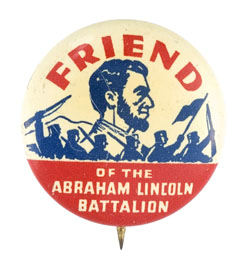
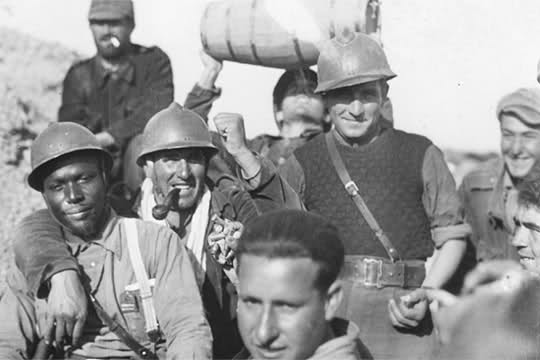

Image result for abraham lincoln brigade


The Lincolns earned much fame and respect, both among their hardened European allies and at home. They fought in every major battle, and with distinction at Jarama and in the Brunete Offensive. But it wasn't enough. Within just a few years, the fascist-backed rebels finally gained the upper hand, and the materiĆ©l-starved International Brigades were forced to withdraw. 70% of the Lincolns had been killed or wounded. Though battered, divided among themselves, and disillusioned with the West, the Lincolns were not beaten. Their stories were soon immortalized in Ernst Hemingway's seminal work For Whom the Bell Tolls and in George Orwell's memoir of the conflict. Within just a few years, they got their chance to help drive a stake in the heart of fascism. And although they were harassed by HUAC and the FBI in the repressive 50s, by the 60s had become renown for their past and continuing commitment to "The Good Fight." Though all gone, they live on in the mythos of American history, so much so that even John McCain, hardly a leftist, is a fan


While the Lincolns and their allies were ultimately unsuccessful at expelling Franco's forces, they were still instrumental in the fight against fascism. Their efforts brought worldwide attention and condemnation to fascist expansionism, and sounded the alarms to coming worldwide war. Many Lincolns served their country with distinction in WWII and later became voices for global justice. And finally, their legacy lives on in those willing to risk their lives and livelihood to protect innocents across the globe. In fact, the anti-ISIS fighters are on track to actually succeed in their goal, something the Lincolns could never do. But as Howard says, once the Islamic State is defeated, then the real work begins. The world failed last time. With people like Howard on the frontlines, we have better reason to hope it won't fail again.

Thursday, July 6, 2017

The "Gift" No One Wants: The Situation in North Korea

Several weeks ago, in response to the latest rounds of North Korean provocations, I reviewed the US's role in the Korean War and expressed my opinion as to whether it was worth it for us getting involved. While I believe it was worth it, it's becoming increasingly clear each month that the work there remains unfinished. In fact, things are becoming downright grim, and honestly for me it's the scariest thing happening in the world right now. 

A review of what's happened this time.

First, there's the tragic death of Otto Warmbier. The American student was sentenced to 15 years of hard labor by the regime last year for trying to steal a propaganda poster while he was in the country with a tour group. During that time he was tortured so badly that he fell into a coma. Perhaps because of this the regime decided they had nothing worth losing and released Warmbier to the US. He died on June 19th, six days after he was returned home. There are still Americans imprisoned in North Korea

Then on July 4th (as a "gift package" to the US on its national anniversary), North Korea successfully tested an Intercontinental Ballistic Missile, the Hwasong-14 that appeared to be capable of hitting Alaska or Hawaii, certainly in range of Seoul or Tokyo. While it's unclear if a nuclear warhead could be attached to the missile, even if North Korea can't now it will be able to soon. This sharply escalated the tensions in the region, and tempers are rising among all parties. (Note: As shown in the graphic below, while the Taepodong-2 appears to have greater range, its test didn't appear as promising as the most recent missile's.) 


So what's the way forward? Right off the bat, no one wants to risk war. Even "surgical" strikes to take out North Korean weapon facilities and launch sites are almost certain to trigger a full scale war in the region, maybe even to nuclear levels. Regardless of political affiliation, even the most ardent hawks are reluctant to risk sparking a full scale war on the Korean peninsula. So that's out.

China, usually seen as the only source of leverage to North Korea, has not been able to make a dent and they probably won't now. Their biggest concern isn't a nuclear-armed regime but the country destabilizing and potentially collapsing, which would flood China with refugees and put an American military base on their border. President Trump has already demonstrated his annoyance with China by selling arms to its rival Taiwan, sanctioning one of its banks, and sending a destroyer to the South China Sea. But frankly the US doing this is only cutting off their nose to spite their faces, even beyond North Korea. The last thing we would want is poor relations with our biggest trading partner, especially considering that they're gearing up to fill the role the US seems to be withdrawing from on the world stage. However, the fact remains that they're not much help on North Korea anymore. 

Diplomacy remains the most viable option. Specifically, the US should try to replicate what the Clinton Administration brokered in the 1990s. This deal eased sanctions and lowered the rate of military exercises in exchange for the North Koreans freezing their weapons program. The deal certainly wasn't perfect, as North Korea snuck in uranium tests on the side, but for the duration of Clinton's presidency, no nuclear warheads were developed by the regime. Even if a similar agreement goes forward, it certainly won't solve the North Korean problem; it essentially would only kick the can down the road for who knows how long. North Korea also just isn't going to give up their nuclear arms, as they see it as their only means of survival, but they might not take it any further for the sake of stabilization in the region. Everyone seems to agree that this is the least bad option out of all the others. 

Though it's a deal with the devil, such an option should be pursued to the fullest degree. War would be catastrophic, and must be avoided. Let's hope the world's leaders understand that. 


Wednesday, June 21, 2017

A Short History of Wars Starting By Accident

The recent headlines of a U.S. fighter jet shooting down not just a Syrian Air Force jet but also one of its drones definitely raised an alarm or two in my head.  It was made even more disconcerting by the fact that the Russians said they would target U.S. warplanes west of the Euphrates River and were cutting their avenue of communication to us. And that's not even accounting for Syria or Iran's feelings about it. It seemed like yet again that the situation in the Middle East was spinning out of control.

Now, I don't think that these two instances will escalate to a war with Russia or even fundamentally alter the current situation in the region. Everyone just might get off easy. However, if the parties involved aren't careful and mindful of the implications of their actions, in the future a similar incident could occur. If heads are too hot, it could prove to be the spark to greater quagmire and bloodshed, if not in Iraq and Syria then elsewhere.

Sadly, there's plenty of wars that by accident. I'm not referring to instances where deliberate attacks were staged with full awareness of the potential consequences, such as the Nazi invasion of Poland or the Confederates firing on Fort Sumter. Nor am I referring to parties being tricked into fighting, like the French in the Franco-Prussian War. No, here are just a few wars that started because some people unable to keep their #$%& together.


  • First World War
Perhaps the most well-known example of a seemingly distant geo-political conflict spiraling out of control. The assassination of the heir to the Austro-Hungarian Empire by the Serbian separatist-terrorist organization the Black Hand quickly roped in treaty-bound (and opportunistic) European nations. Austria-Hungary threatened war with Serbia if its government wouldn't turn over the terrorists. Then Russia jumped in to protect a fellow Slavic/Eastern Orthodox nation. Then Germany stood up for its ethnic German sibling and attacked Russia...'s ally France first because they bordered Germany, which drew Britain in shortly after. Within a couple of short months, a Balkan regional squabble had escalated into a full-scale European war, engulfing the world within a few years.

  • Sino-Japanese War
China had already been mired in civil war between communists and nationalists, and in 1931 the Japanese decided to take advantage of the chaos and annex Manchuria in the north, renaming it Manchukuo. Then 1937, nationalist soldiers traded shots with a Japanese dispatch along the Yongding river outside of Beijing. The skirmish itself passed without incident as no one was killed, but the next day when a Japanese soldier was missing at roll call, it was all the Japanese command needed. By the time that soldier returned from the local brothel, fighting had already broke out and in just a few weeks the Japanese crossed the Marco Polo Bridge into China proper. 
  • Seven Years War
Frederick the Great of Prussia thought (with good reason) that the rest of Europe was gearing up to attack him. So in 1757 Frederick launched a preemptive attack against where his enemies would most likely strike, Saxony. Though the attack itself was perfect, unfortunately Frederick guessed the wrong country, and it turned out he attacked a neutral country without a declaration of war or a provocation. This made it easy for Russia, France, and Austria to declare war on Prussia. However, Frederick's tactical brilliance and huge war chest would keep the war going for years. 

Again, these are just a few examples of wars, and and only wars. That being said, we shouldn't get ahead of ourselves and curse past stupidity. Just because some of these wars started by accident doesn't mean they probably weren't going to happen at all. In many cases, one or both sides were itching for a fight anyway and it would have come to blows sooner or later, by accident or on purpose.

The point is that wars rarely, if ever, start from nothing. Tensions often grind on for years or even decades between parties, steadily escalating until someone makes one final provocation and someone else starts shooting. Long fuse or not, the spark has to be snuffed long before it reaches the dynamite.

Sunday, June 18, 2017

The Only History Book You'll Ever Need to Read

If I was only ever to do one review of anything for this blog, it would be for The Great Big Book of Horrible Things, by Matthew White. If you seem unsettled, or skeptical with the title, don't; I really don’t think anything else I would potentially recommend would surpass or even equal the impact that this book would have on you, as it did for me when it was first bought for me as a throwaway Christmas present five years ago.

Neither a macabre coffee table book nor an impossibly dense collection of stats, this book is essentially an editorialized reference book. Now that may seem like a contradiction, and in most cases it would be, along with being not all that interesting. But White, a self-described “numbers freak” with a gift for historical writing masterfully weaves bold classifications with sober analysis and goofy commentary to create an utterly unique work, one that almost seems unrecognizable from others. White's goal in this book is to bring the best justice he can to the countless of overshadowed or altogether forgotten victims in historical killings, and those efforts shine bright. Horrible Things is credited by distinguished psychologist Steven Pinker, who provides the foreword, as the "the most comprehensive, disinterested and statistically nuanced estimates available." Ever since I’ve read it, I’ve tried to emulate White’s approach and style and I’ve proudly cited it multiple times in my own reports.


In assessing history's deadliest man-made events, White, who has no formal training in history or statistics, approaches the subject with a scientific method. He rejects consensuses about the death toll of a given event, instead going straight back to primary and secondary sources. He throws out the highest and lowest numbers and plugs in the median. How does he get these sources, you ask? "The short answer is money," White replies. "Even if a general is reluctant to tell the newspapers how many men he lost in a bungled offensive, he still has to tell the accountants to drop 4,000 men from the payroll... Head counts (and by extension, body counts) are not just an academic exercise; they have been an important part of government financing for centuries." The length of each chapter is proportional to the deadliness of the event.

However, it's not the numbers that are of the most interest in this book, even if it is the selling point. It's how White incorporates them into his writing. Each chapter is categorized rather surprisingly, and loaded with unexpected, juicy terms of White's invention, like 'atrocitology,' 'multicides,' and 'hemoclysm' that capture the reader's imagination much more than dry terms like 'genocide.' His commentary captures the ironies, tragedies, and downright absurdities of history. Here are some examples, starting with his chapter on Timur:

TIMUR
Death toll: 17 million
Rank: 9
Type: world conqueror
Broad dividing line: Timur vs. everyone he could get to
Location: central Asia, the eye of the hurricane being Samarkand
Who usually gets the most blame: Rimur; also called Tamburlaine (old version) or Tamerlane (newer version) from his insulting nickname, Timur Lenk ("the Lame")
Another damn: Mongol invasion

Here's an example of White describing Saladin In his Crusades chapter (3 million deaths):

In reality, Saladin's sense of honor was flexible... []Two leading crusaders were brought to him in chains. He fed the first one, explaining that the rules of hospitality now forbade him from killing a prisoner who had been given food and drink by his captor. Another prisoner... lunged for a cup of wine and downed it before anyone could stop him. [He] thought, Aha! I'm safe! But Saladin killed him anyway because no one likes a smartass.

White understands, however, the issues and contention that really do affect our modern life and knows when to be serious, not tolerating some minority opinions. Believe it or not, there's a sizable minority of people who believe that the Western democracies fought on the wrong side of WWII (along with the faction that denies the Holocaust). White responds with this: 

In this case, revisionists seem to forget the world went to war against Hitler because he was dangerous, not because he was evil. This is an important distinction in international relations. You can do whatever you want inside your own country, but when you start invading your neighbors, the rest of the world gets jumpy. No matter how brutal Stalin may have been to his own people, he was content to stay inside the borders of the Soviet Union. By the time Stalin began grabbing small countries for himself, the West was already committed to war with Hitler. The choice wasn't between fighting Hitler or Stalin. The choice was to fight Hitler or both of them.

Despite his unorthodox form and his use of black humor, it’s understandable to think that reading White’s book about humanity’s worst achievements might get a little depressing after a while. However, with each chapter I absorbed, I got steadily more excited until I felt downright enlightened by the end. This is because what happens as you travel across time and the world in White’s book is that you feel a remarkable sense of discovery. Because of White’s information, style, and arguments, you really do feel that you understand not just history but humanity so much better. White passes the historian’s ultimate test with flying colors and imprints it on the reader: He effectively makes history relevant to the reader, and uses it to better understand our present and prepare for the future. It worked for me and it will surely work for you. 

For more on Matthew White visit his website (don't be fooled, it deliberately looks old-school) or the New York Times review of Horrible Things.

To check out the book itself, click here

Tuesday, June 13, 2017

Was the US Getting Involved in the Korean War Worth It?

A friend of mine, who is from China, already seems to have a lifetime full of stories. One she doesn’t consider especially noteworthy—but I certainly do—is her trek to the Chinese-North Korean border.

“It’s really boring,” she says dismissively, “there’s nothing there and it takes hours of hiking to get to it.”

Considering that the Demilitarized Zone (DMZ) of North Korea and South Korea is one of the most militarized, increasingly dangerous borders in the entire world, maybe you can understand my amazement at how the situation seems completely different a few hundred miles north.

Though recently overshadowed by domestic political crisis and Islamic State-related attacks, the threat posed by North Korea, steadily growing with each provocation and nuclear missile test should arguably be taken more seriously than any other global security threat. With events like these, it got me thinking: was the Korean War worth fighting if it only led to this increasingly unstable stand off? Was too little, or too much for that matter done all those years ago? 

For this piece, I won’t give the same amount of context I usually give for a historical event. Rather, I’ll try to talk solely about American involvement in the war and assess its gains and losses, and have it serve as a potential introduction for another post in the future.

The Korean War, succeeding the Second World War and preceding the Vietnam War for American forces, is often forgotten due to being sandwiched between these greater conflicts. While WWII is perennially considered a, ‘good’ war, and Vietnam a ‘bad’ one, which side does the Korean War fall on, if any?

The first major post-WWII conflict of the Cold War was never intended to take place in Asia, but rather in Europe. Neither the Americans nor the Soviet Union wanted to fight there, even though they were each backing their own puppets in the region, north and south, respectively. Kim Il-Sung however, founder of the Democratic People’s Republic of North Korea following the Japanese surrender, and installed by the Soviets, decided to take his chances and reclaim the southern Korean peninsula. The South was lightly defended, and its capital, Seoul, was captured in a matter of days. It was expected that the rest of the country would soon follow. However, President Harry Truman shocked the world, and much of America for that matter, by throwing US troops stationed in Japan into the fray and stating his determination to protect the South.

Truman’s rationale for this was that communism simply could not be allowed expand from where it already existed, otherwise one country after another would fall under the communist influence. US commitment sent a clear message to the Soviets in particular that hostile military takeovers of free (and "free") countries would not be tolerated. However, as we'll see later on, the US-led forces in Korea soon overplayed their hand.

So far though, American forces weren’t doing much protecting. For the first time in American military history, the Americans were forced to retreat on a large scale in the face of overwhelming North Korean numbers. With their backs to the wall in the southeast corner of Korea, Pusan, the odds didn’t look good. Then General Douglass MacArthur, hero of the Pacific in WWII launched an amphibious invasion behind the North Korean lines at the port island of Inchon. With the North Koreans cut off, within a few months American-led forces recaptured Seoul and pushed them back to their border.

The war could have ended there. However, MacArthur, sensing blood in the water, wanted to invade North Korea and finish the job, knocking the communists out of North Korea. Truman was uneasy. Defending the South from communist aggression was one thing, but driving through the North would alter the pre-war communist boundaries and status quo of Asia. He was worried China might perceive such a move as a threat. However, Secretary of State Dean G. Acheson and MacArthur advised Truman that China, led by Chairman Mao Zedong, was too concerned with building their own nascent People’s Republic and consolidating their power. An intervention would not be in their interests. With this advice, Truman gave MacArthur approval, and within another few months, the North Korean forces were driven back to their northern border along the Yalu River. Victory was within reach.

However, Mao and the Chinese Politburo saw the invasion as a direct threat. A US base along its border could mean they themselves could be invaded in the near future. As a result, the war was of vital interest into the Chinese. In one of the more understandable things Mao has ever done, without any warning he quietly flooded North Korea with Chinese troops, taking American forces by surprise. Once again half of Korea was rolled over by an invading force, but the American-led forces made a stand at the 38th parallel. After that, there’s not much to say about the war. Over two years, little change came to the stalemate that formed there. The key point however is how the war ended. What happened was simply an end to the fighting was negotiated (the sticking point for a long time were prisoners of war returns for both sides) and reluctantly agreed upon. No ‘armistice’ or peace treaty was signed. That means we, along with South Korea, are still technically at war with North Korea, 64 years later.

So where does that leave us today? In the decades following the war, for a while the North Korean GDP per capita was larger than the South’s. However, in the late 70s and early 80s, the South Korean economy took off and its hard-right government liberalized. Today, South Korea is an incredible success story of a country with few natural resources. It has one of the largest GDPs in the world, a flourishing democracy, has gifted the world with numerous products and is an excellent global citizen. North Korea, by contrast, has doubled and tripled down on its tyrannical rule, especially after losing its strongest backer with the fall of the Berlin Wall. North Korea is one of the poorest, most illiberal places to live and its government has grown increasingly erratic, desperate even, and has grown increasingly dangerous. It is a “loose-cannon” in every sense of the phrase, aggressive enough to provoke the world but risking even full-scale nuclear war if it perceives any outside response as a threat. It believes disarmament invites annihilation, or reunification, which for them without Kim Jong Un leading would be even worse. There are certainly options available for disarmament—consistent sanctions and cooperation with China to use their leverage on the North is probably the best option. However, that policy needs to be fundamentally overhauled, otherwise it risks falling apart.

So did the 35,000 American troops killed in the war and the thousands of others who fought in it do so for a good cause? I believe so. Not only did their actions save South Korea, a country that bloomed into an invaluable gift to the world that otherwise would have made the Northern regime even stronger, their actions likely saved more. Under Truman’s “Containment” doctrine of communist countries, those troops sent a clear message to communist countries that they would not allow invasions to go unopposed. Such an action in Korea likely prevented one occurring in Europe, which would have involved the Soviet Union and would have risked all-out nuclear war. These men indeed gave their lives for good.

However, the work they were thrown into is undone. War cannot be allowed on the Korean peninsula again. It carries grave risks for the region and possibly the world. I don’t think most people understand that, something that could have dire consequences maybe sooner than later.