Showing posts with label News. Show all posts

Tuesday, August 1, 2017

The Lincolns Live On: Taking the Fight to the Enemy

A very troubling trend that's been occurring for the last several years, and often appears in headlines, are Muslims from the Western world either going to Iraq and Syria to fight for the Islamic State or pledging their allegiance to it and staging domestic terrorist attacks. These people are both teenagers and adults, men and women, and many are citizens of America, the UK, France, etc. It's estimated that well over 27,000 foreigners have traveled to ISIS's  "caliphate" to fight for them, and that study is a year old and doesn't even account for those who pledge their loyalty then stage a terrorist attack at home.


Image result for isis political cartoons 2017


However, while disturbing and dangerous indeed, the good news is that ISIS members are not the only ones fighting not to mention there's plenty of ISIS recruits who aren't exactly crack troops (discretion advised). Right from the start of the new conflict in the Middle East, volunteers in the hundreds from all across the world have gone to take the fight against ISIS. Although the initial report was from a year ago, it states 300 fighters from 26 countries, almost entirely from the West, have joined anti-ISIS forces. There are well over a hundred Americans there. The volunteers have diverse backgrounds, have different motivations for fighting, and have extraordinary experiences.

Many are Iraq war veterans, returning to finish the work they started almost fifteen years ago, or have found they can't return to civilian life. Some are anarchists, hoping to kick out ISIS and build their own stateless society. All to at least some degree seem motivated to protect Christians and other civilians in the area, especially women, and fight evil. To me one of the most interesting stories is Kevin 'Christian' Howard's. A former soldier who served in Iraq, he befriended many people in minority ethnic groups in the region only to find out they were killed by ISIS several years later. He returned to bring justice to those who killed his friends and the hundreds of others killed in terrorist attacks across the globe.

Though I'll admit there's plenty of darkness in this man he does write the locations of terrorist attacks on his bullets after all, and who knows how well he readjusted to civilian life? the devotion he feels to those oppressed in the region and the absence of rabid hatred towards his enemy if quite formidable. Moreover, the absolute hope that he has in the defeat of the Islamic State and the cool confidence he has that various ethnic and religious groups can coexist in peace is a potent antidote to the pervasive cynicism of today. And I mean, it's not like he's just talking about helping these people, he's actually doing it.


Image result for kevin howard soldier

However, Howard and his partners are not the first to take part in "the Good Fight" when their country wouldn't. They follow in footsteps of thousands of their countrymen over the last century who fought the bad guys before it was cool. While scores of volunteers joined the French or British military during the World Wars, the most famous Americans to ever fight in a foreign war was when their government didn't jump in at all: The Abraham Lincoln Brigade in the Spanish Civil War.

No one thought there would be a war in Spain at the time. In fact, Spain was seen as a success story in the world. With the Depression in full swing, it seemed increasingly likely that every developed country in the world was going to swing either far right (like in Germany or Italy) or far left (like in the Soviet Union.) But by 1935, the democratically elected Liberal/Socialist/Communist coalition—the Popular Front—was lifting thousands out of poverty without falling to an extreme. However, General Francisco Franco led a revolt against the government for their assaults on the Ancien Regime. Before long, Hitler and Mussolini started pouring in men, machines, and money into Franco's hands in order to test out what they'd been cooking up over the years. The Spanish Civil War proved to be a "rehearsal" for the Second World War.

The world responded in kind. Although the fascist attempt at a hostile takeover shocked the international community and turned them against fascism, few were willing to actually stand up to them at this point and help the government. Thanks Neville. As a result, an estimated 35,000 people, mostly from Europe, smuggled themselves into Spain and fought on behalf of the government in International Brigades. These included roughly 2,800 American volunteers, many of whom were leftists, Jews, and people of color who served together. All were motivated by a sincere desire to fight evil and stop the spread of fascism across the world.

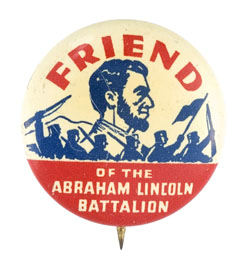
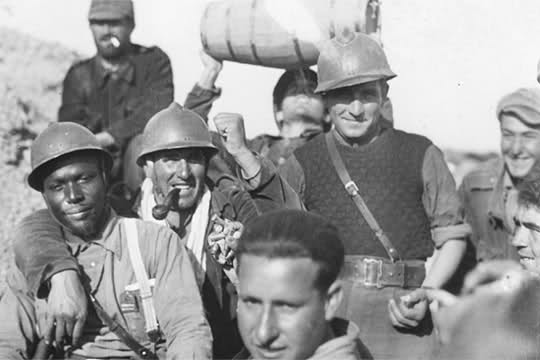

Image result for abraham lincoln brigade


The Lincolns earned much fame and respect, both among their hardened European allies and at home. They fought in every major battle, and with distinction at Jarama and in the Brunete Offensive. But it wasn't enough. Within just a few years, the fascist-backed rebels finally gained the upper hand, and the materiĆ©l-starved International Brigades were forced to withdraw. 70% of the Lincolns had been killed or wounded. Though battered, divided among themselves, and disillusioned with the West, the Lincolns were not beaten. Their stories were soon immortalized in Ernst Hemingway's seminal work For Whom the Bell Tolls and in George Orwell's memoir of the conflict. Within just a few years, they got their chance to help drive a stake in the heart of fascism. And although they were harassed by HUAC and the FBI in the repressive 50s, by the 60s had become renown for their past and continuing commitment to "The Good Fight." Though all gone, they live on in the mythos of American history, so much so that even John McCain, hardly a leftist, is a fan


While the Lincolns and their allies were ultimately unsuccessful at expelling Franco's forces, they were still instrumental in the fight against fascism. Their efforts brought worldwide attention and condemnation to fascist expansionism, and sounded the alarms to coming worldwide war. Many Lincolns served their country with distinction in WWII and later became voices for global justice. And finally, their legacy lives on in those willing to risk their lives and livelihood to protect innocents across the globe. In fact, the anti-ISIS fighters are on track to actually succeed in their goal, something the Lincolns could never do. But as Howard says, once the Islamic State is defeated, then the real work begins. The world failed last time. With people like Howard on the frontlines, we have better reason to hope it won't fail again.

Saturday, July 29, 2017

Interview with Bob Galante: Part II

This is the second part of an interview I've conducted with the historian and teacher Bob Galante. To read the first part, click here.


On Fake News

It's no secret that our society has had political tumult in the last two years. There is no doubt that our discourse has become radicalized. I do think that social media has a lot to do with that. We are in a new phase of our history, and the new kinds of communication technologies have arisen that have changed people's relationship to information and ideas. It is a worrisome trend that families are split over political questions and friendships seem to be dissolving at this point as well. It is saddening to think that Americans now may be resembling the Sunnis and Shia.

Part of the problem with fake news is that any kook with a modem and a camera can create any story they want and broadcast it to the world in just a few moments. There have been some documented cases in the New York Times a couple months ago, in November, about how fake news spreads throughout the Internet. As Mark Twain once observed, a lie gets halfway around the world before the truth can get its shoes on. I think we're seeing that idea writ large in the instantaneous global communications that we now have. Add to that the emotional human desire to believe what we want to believe. It seems in our society today, the stories people want to tell themselves matter more than the realities they're enduring.

Teachers need to elevate the discourse with their students. To present to the students ideas of greater sophistication, more detailed factual bases, court issues and problems, to keep the students reading, writing, and thinking. While for some people it's a dark moment that our society has political tumble, it can also be a gold mine of teachable moments for teachers.

One thing teachers can do to help on this is to keep the students grounded in core questions within their curriculum, [in order to make] students truly interested in the problems. Look for ways to create consensus over things like crime and punishment, the budget, alliances overseas, war and peace. There is still much consensus in American society. The foundations of our institutions are strong. America's Constitution is durable, it has proven the test of time. Through many dark times [like] 1862 [and] 1942. These were dark times as well and we did not know the outcomes of the day’s events either and America turned out okay. Keep the students grounded in their roots as Americans in our unifying principles.

On Facts vs. Ideas in History Education

Too many of America's history teachers are just dragging their students through a parade of dates and facts. Teachers are packaging their students. Do you recall that video of that young man that berated his teacher for not teaching? He urged his teacher to stimulate the students and "touch their hearts." Some people say the boy was insolent, but others say you know he deserves a medal.

In any case there can be too much emphasis on just facts and the [bare] information of history. What teachers need to do is give students the ideas of glue that hold the facts together in the first place. In an age where students can Google anything, get any piece of information or nearly any document they want, it is essential that we teach them how to think.

The role of the history teacher is to show students how to build arguments, to anticipate and refute counterclaims, to integrate the best and most relevant factual records.

Clearly, Bob knows his stuff, both from personal experience and devoted study. I'm very grateful he was able to pass along so much knowledge to me, and by extension all of you. He is a rare voice of clarity and wisdom for the times we live in, but he's not just a man of words. Indeed, whether by researching and learning, teaching others, or refusing to accept the proliferation of BS in our lives, we can all follow in Bob's example for the rest of our lives. There's no time like the present!

Wednesday, July 26, 2017

Stomping on History

Quick post for today.

So this morning President Trump announced over Twitter that transgender individuals are now barred from serving the American military "in any capacity." Trump's reasoning for this was that the military could no longer be burdened with "the tremendous medical costs and disruption that transgender in the military would entail." Most likely this was a favor to Vice President Pence, a longtime opponent of LGBT rights.

I know this sounds bad but I have news that will make this worse.

Who knows if this was by coincidence (it probably wasn't) but the day Trump chose to implement this ban is shocking. Because on July 26, 1948, President Harry Truman signed Executive Order No. 9981 to begin dismantling racial segregation in the military "as soon as possible." It remains a milestone for the history of the military and for the Civil Rights movement in America. 

And then Trump does the opposite kind of thing on its anniversary.

Normally I would post a picture of a facepalm or something but honestly this is kind of heartbreaking. I can't imagine what it's like for the trans serving, served, or thinking about serving, with their country's president basically saying they're worse than useless. 

Stay frosty friends. 

Monday, July 24, 2017

Fake Quote Found!

Believe me, I didn't plan this.

In a recent post, I discussed the perpetuation of fake quotes from historical figures on social media and how to spot them. To summarize, in my opinion the problem stands to be just as serious as fake news in the long run. Though there are plenty of cases of people mistakenly sharing fake quotes that are mostly benign, there are plenty of others who do it on purpose. The goal of these sharers is to appropriate an historical figure so they can justify their own point of view in the present, often distorting the figure and what they stood for. 

Enter Anthony Scaramucci.

For those who don't know, Scaramucci is the White House's new Communications Director. The appointment was so controversial that it caused the White House Press Secretary Sean Spicer to resign, effectively ending one of the best SNL segments in years. His anger can be understandable, considering that Scaramucci, a Wall Street financier, doesn't seem to have much experience in the role he was given. Moreover though, perhaps Spicer's real beef with him was the fact that Scaramucci was once a Trump-basher who apparently decided to let bygones be bygones when opportunity knocked. Just another day in the Trump White House.

But the real story here has to do with Scaramucci's Twitter account. He's been trying and mostly failing to delete tweets that were critical of Trump and expressed views that were contrary to his. Though non-political, one that popped up and has not been deleted was this one: 


You already know where this is going, right? Yup, fake. Mark Twain never said that. I mean I was expecting to find a fake quote at some point after my post about it but come on! 

Should it be disconcerting that the Communications Director of the White House, whose job it is to be the conduit between the President and the press (and by extension the country), didn't bother to check his sources before he shared a quote he liked? You decide. 

Remember friends, BS is everywhere. Keep your eyes open for it, always. 

Saturday, July 15, 2017

Fires Never Go Out of Style: A History of Riots in America

This week marks the fiftieth anniversary of the 1967 Newark Riots. Rumors of the police beating a black cab driver during his arrest was the spark for city-wide rioting. Even though the rumor later proved to be false, the long marginalized, abused, and impoverished black community didn’t need much provocation to strike back at the mostly white police force. 

For five days, Newark’s rioters and police clashed while bystanders and emergency services found themselves caught in the crossfire. The New York Times has an illuminating retrospective on the riots and its legacy to Newark. Many consider the riots to be the final nail in the coffin for Newark and it’s only just now starting to come back. Others believe that despite the violence and damage (or perhaps because of it) at least the black community finally got a voice in the city. Perhaps both or neither or true. But I thought this would be a good time to review the riots in American history: when and why they occurred and what the trends were.

Image result for riots

Riots are in effect volcanic reactions from a society, or a sizable segment of it, against authority for their conduct, obstinacy, or negligence to immediate issues affecting that society. While protests, violent or peaceful, are generally organized enough to stand for or against a given issue with specific demands, riots are chaotic and fervent; it’s like a wound-up rubber band snapping loose right on your face. Even if the root causes of a riot are unclear at times, the more-often-than-not single event that sparks the riot usually prove to be a major indicator of the perceived wrongs that authority has inflicted on that society.

The major trend in riots for over fifty years right to the present has been due to racism, through different avenues. For many the recent riots in Ferguson and Baltimore come to mind, in response to claims of police misconduct and brutality that led to the deaths of young black men. This is not unlike the Los Angeles Riots of 1992 when the police beating of Rodney King was captured on camera and the officers were acquitted. The same issue was present for the 1965 Watts riot in Los Angeles and Newark’s. 

However, for each riot the root cause was not just police brutality. Regardless of your politics, it’s clear that both then and now most black (and brown) people in inner-city areas simply do not have the same opportunities as even other black and brown people do elsewhere, let alone white people. The fact that race riots have been occurring sporadically for over fifty years show how little progress has been made in many areas pertaining to race.

However, America hasn’t been subject to just race riots. While European riots (along with much of Europe in general) are known for their black-bloc, Molotov cocktail-throwing masked protesters/rioters, America has had its fair share of similar political and economic riots. They’re actually the inspiration for some of the best Rage Against the Machine songs. Though it may surprise you, there's a long history of labor movements peppered with socialism and anarchism in American history, and some of those strikes devolved into riots. 

One notable example are the riots that broke out during the large-scale Railroad Strike of 1877, leading to widespread chaos across industrial centers in America between workers and state militia and federal troops. Much of this tradition continued well into the twentieth century when labor became more organized and progress was deemed too slow. In an era when organized labor's power is all but eradicated, these stories can be especially surprising. Nowadays, it's arguable that Antifa is trying to pick up the slack.

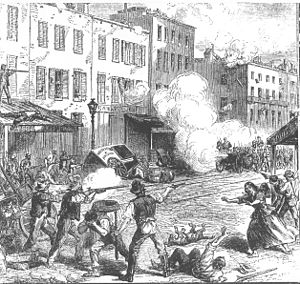
Then of course there’s class riots, and that arguably has been the main trend in riots for all of American history. Even if it seems to be buried under race and politics, believe me, if most of these rioters had a better standard of living, they would have stayed home. Even before our nation was officially founded, there are documented cases of workers and farmers revolting against their bosses or landlords up and down the East Coast. The most prominent of these types of riots was the New York City Draft Riots of 1863, which remain the deadliest riots in American history. This was in response to the draft that Congress initiated to replace massive Union losses in the Civil War. While it was at its core an initiative to stimulate volunteering, it was clumsily executed and enraged much of New York City’s population, which proved to be a cocktail of destruction: much of its industry was cotton based and connected to the South so they opposed the Civil War, and much of its workers were poor Irish immigrants who did not want to compete with black people for low-wage jobs, or rabid Nativists who didn’t want to compete with either of them. When a fire company’s chief was drafted, the firemen destroyed the local draft office and kicked off a city-wide revolt. For five days the city burned and both black people and Republicans were targeted by the rioters. It was finally put down with Federal troops fresh from the Battle of Gettysburg. 105 people were killed—eleven black people, eight soldiers, two policemen, and the rest rioters. Other than the Civil War itself, the riots remain the single-largest insurrection in American history.

Image result for nyc draft riots


And these are just events that can be solely classified as riots. They don’t account for the overwhelming amount of (mostly) peaceful protests (Vietnam, WWI) or the outright rebellions that occurred (Shays’ Rebellion, Southern secession). Along with riots, these reactions to authority show that American history is not a straight and clean line. It has many twists, turns, stutters, and splinters, but also progress. Whether a reaction is a protest, riot, or rebellion, if any of these events occur, authority is forced to take notice if they don't want their cities to burn. 

Wednesday, July 12, 2017

"How to Spot Fake Quotes on the Internet"- Abraham Lincoln

There's hardly any doubt now that fake news is a big problem (not to mention determining just what is fake news). However, that's not the only thing catching fire on social media nowadays. Fake quotes are a big problem too. As I've witnessed firsthand, quotes either falsely attributed to historical personages or taken out of context have officially reached meme status long ago. 

Case in point: I remember several years ago a distant aunt of mine shared a picture of Abraham Lincoln on Facebook with a quote:


Image result for lincoln you cannot bring about prosperity

Stunned at first, I soon smelled a rat. I'm somewhat of a fan of Abraham Lincoln, and though he definitely said and wrote a lot, I had never heard this before. In fact, such an overemphasis on libertarian-capitalism seemed out of character for Lincoln, considering his unprecedented expansion of government power to free slaves. That was strike one. And let's not forget that Lincoln was one of the greatest orators in American history. So if he was going to say something like this, he would probably would have found a more rhetorically effective way to do so other than cataloging. That's strike two. Finally (and appropriately) I did some quick googling and voilĆ”: FAKE! In fact, the quote is actually from the pamphlet of a conservative German-American Presbyterian Minister, published over fifty years after Lincoln's death. Even now, I'm annoyed with my aunt sharing such a ridiculous falsehood.

While there are plenty of relatively benign cases where an inspirational quote turns out to be inaccurate, this issue shouldn't be underestimated. Anyone with an agenda can potentially appropriate a historical figure to justify their views, and make people believe those figures stood for something completely different than they did. This goes back to one of my earliest posts about using history to justify the present, often falsely. Whether it's gun owners believing Ghandi opposed gun control or video-gamers thinking that Stalin was self-aware, this proliferation of fake-quotes not only influences today's politics and culture but can change the perception of history itself. In the long-run, that's just as dangerous as fake news, if not more.

So to summarize, how to spot fake quotes online:

  1. Go with your gut. If at any point someone is sharing a quote to justify one of their viewpoints or argue for it better than they could, your BS alarm should be active. While it may be tempting to take a shortcut and assume that previously unheard of quotes from famous people are fake, you shouldn't: many "well-known" quotes are often inaccurate too. To be honest, it might be best to just take every quote shared from a historical figure on social media with a grain of salt at least at first.                                                                                                                                  
  2. Context, context, context. Even if they don't mention Twitter or tacos, someone living 500 years ago wouldn't use the same vernacular we do, especially if they spoke another language. Try to find clues in the "quote" that give the real author away.                                                                  
  3. The most important step of all: fact check. Snopes is an excellent site that shuts down fake news and memes circulating on the internet. However, a simple Google search will do provided you do it right. I have to stress here that if you really want to get to the bottom of the story, go down the page: often the first few lines of a unspecified Google search either won't help you or confuse you more. It will take thirty seconds to a minute longer, but trust me, the research you do will be worth it to get to the truth. 
Happy hunting of fake memes my friends. Before I part, I'll leave you with some wise words from one of our Founding Fathers: 

Image may contain: 1 person

Tuesday, July 11, 2017

A Marriage of Convenience?

Sometimes you have to just call things as you see them, and Nicholas Kristof does just that. In a recent blog post, the New York Times contributor offered his "takeaways" regarding Donald Trump and Russian President Vladimir Putin's highly anticipated first face-to-face meeting. Some would hardly surprise you—it is titled "Did Putin Have Trump for Lunch?" after all. Still, Kristof's commentary was concise and precise, and helped contextualize the G-20 summit as well as the impact that Trump and Putin, both separately and together are having on the world.

Kristof asserts that it is absurd for Trump to accept Russia's account on interference in the 2016 election over our own intelligence agencies, none of which, despite what the President says, are in dispute of Russia's efforts. It's also very disconcerting that Trump's attack on the news media (and bullying of our allies) seems to be one of his priorities, so it's altogether fitting for him to stand shoulder-to-shoulder with the leader of a country that saw 58 journalists murdered and regularly defies the international community. Kristof goes on to elaborate his worries about the American withdrawal from the global stage and the dangers of Russia or China filling in the vacuum over, say, the European Union. There's also a significant danger that as the investigation of the Trump/Russia collusion continues, what little credibility Trump still has will dry up and he will become even more erratic. This could lead to wild cards like North Korea or Venezuela taking risks and provoking a disproportionate response. Kristof convincingly argues that our foreign policy is rapidly flipping upside-down.

However, I think that Trump and Putin's meeting planted the seeds (or showed existing ones) of a potential conflict in the future, one that Kristof did not touch upon: Trump vs. Putin. It sounds ridiculous even by today's standards for what passes as possibility, but hear me out. I think we can all agree that both Trump and Putin are two of the most prominent opportunists in the world. Ever since the fall of the Berlin Wall, whether as KGB head, Prime Minister, or President, Putin has done nearly everything in his power (and some things arguably beyond) to push back against Western political and economic influence. Despite these acts prompting international backlash against Russia and claims that Putin could push his luck for only so long, he's been thriving. Enter Trump, an equally opportunistic man willing to challenge anyone who stands in his way and fan the populist flames that had been spreading across America even before 2016 by promising to "clear the swamp" of American politics. Trump's motivations seem much less clear than Putin's (unless it really is just something like pungent narcissism) but is just as strong, if not more.


 Image result for shaking hands double cross


Why wouldn't these two make a marriage of convenience? It's not like there's no history of it ever happening in Russia. Just in the last century alone, Russia signed two deals with their devils at the time. The first came in 1894 with the Franco-Russian alliance, then in an expansion in 1907 with Britain, later known as the Triple Entente. Though meant to counteract the rise of Germany, an alliance between two democratic and liberal countries and such a backwards and authoritarian one like Russia proved to be embarrassing to all parties. Its much more notorious sequel came in 1939 with the Molotov–Ribbentrop Pact, a non-aggression pact between a fascist Germany and a communist Russia, which by anyone's account should be natural enemies (as they soon proved to be). Hitler proposed it to cover his back for when he went to war with Western Europe later, Stalin did so in order to gobble up Eastern territory. Such cynically opportunistic act from both nations shocked the world. So why wouldn't Russia, who's been on the losing end on the global stage even before 1989 be willing to try it again?

The problem with these sorts of arrangements is that they rarely last because they stand on such shaky ground between untrustworthy parties. While it's absolutely not certain to happen, I believe it is possible that there will come a time when Trump and Putin will turn against each other. Maybe it will be over Russian intransigence in Syria, or a trade deal gone wrong, or one or the other finally overplay their hand. While we shouldn't be afraid of this yet, since there's so many other pressing concerns at this time, I think it would be prudent to keep such a possibility in the back of our minds. Because as many of us know, conflicts stemming from friends-turned-enemies are not pretty.

Thursday, July 6, 2017

The "Gift" No One Wants: The Situation in North Korea

Several weeks ago, in response to the latest rounds of North Korean provocations, I reviewed the US's role in the Korean War and expressed my opinion as to whether it was worth it for us getting involved. While I believe it was worth it, it's becoming increasingly clear each month that the work there remains unfinished. In fact, things are becoming downright grim, and honestly for me it's the scariest thing happening in the world right now. 

A review of what's happened this time.

First, there's the tragic death of Otto Warmbier. The American student was sentenced to 15 years of hard labor by the regime last year for trying to steal a propaganda poster while he was in the country with a tour group. During that time he was tortured so badly that he fell into a coma. Perhaps because of this the regime decided they had nothing worth losing and released Warmbier to the US. He died on June 19th, six days after he was returned home. There are still Americans imprisoned in North Korea

Then on July 4th (as a "gift package" to the US on its national anniversary), North Korea successfully tested an Intercontinental Ballistic Missile, the Hwasong-14 that appeared to be capable of hitting Alaska or Hawaii, certainly in range of Seoul or Tokyo. While it's unclear if a nuclear warhead could be attached to the missile, even if North Korea can't now it will be able to soon. This sharply escalated the tensions in the region, and tempers are rising among all parties. (Note: As shown in the graphic below, while the Taepodong-2 appears to have greater range, its test didn't appear as promising as the most recent missile's.) 


So what's the way forward? Right off the bat, no one wants to risk war. Even "surgical" strikes to take out North Korean weapon facilities and launch sites are almost certain to trigger a full scale war in the region, maybe even to nuclear levels. Regardless of political affiliation, even the most ardent hawks are reluctant to risk sparking a full scale war on the Korean peninsula. So that's out.

China, usually seen as the only source of leverage to North Korea, has not been able to make a dent and they probably won't now. Their biggest concern isn't a nuclear-armed regime but the country destabilizing and potentially collapsing, which would flood China with refugees and put an American military base on their border. President Trump has already demonstrated his annoyance with China by selling arms to its rival Taiwan, sanctioning one of its banks, and sending a destroyer to the South China Sea. But frankly the US doing this is only cutting off their nose to spite their faces, even beyond North Korea. The last thing we would want is poor relations with our biggest trading partner, especially considering that they're gearing up to fill the role the US seems to be withdrawing from on the world stage. However, the fact remains that they're not much help on North Korea anymore. 

Diplomacy remains the most viable option. Specifically, the US should try to replicate what the Clinton Administration brokered in the 1990s. This deal eased sanctions and lowered the rate of military exercises in exchange for the North Koreans freezing their weapons program. The deal certainly wasn't perfect, as North Korea snuck in uranium tests on the side, but for the duration of Clinton's presidency, no nuclear warheads were developed by the regime. Even if a similar agreement goes forward, it certainly won't solve the North Korean problem; it essentially would only kick the can down the road for who knows how long. North Korea also just isn't going to give up their nuclear arms, as they see it as their only means of survival, but they might not take it any further for the sake of stabilization in the region. Everyone seems to agree that this is the least bad option out of all the others. 

Though it's a deal with the devil, such an option should be pursued to the fullest degree. War would be catastrophic, and must be avoided. Let's hope the world's leaders understand that. 


Wednesday, July 5, 2017

Robert E. Lee Never Deserved Your Respect

I recently posted about the anniversary of the Battle of Gettysburg, and I found that I still had more to say that directly related to current events. The very reason I started this blog was in response to the growing calls for the removal of Confederate monuments in the South, and the frankly amazing fact that many were indeed taken down. None mattered more symbolically than the statue of General Robert E. Lee in New Orleans. His monument was one of the most hotly contested, and was subsequently the most satisfying of the removals when he was finally lowered from his pedestal, literally and figuratively. It really was a remarkable occasion, made more so by Mayor Mitch Landrieu's moving speech about the historical significance of the event; it's a major step forward to right the wrongs of the past.

I wish I could have been there, because years before the widespread calls for Confederate monument removals, Robert E. Lee was on my $#%& list. Unlike many other Civil War historians, even out of the ones that have no qualms labeling the Confederacy for what it was— an Empire of Slavery— there still remains a professional and personal admiration for Lee. They cite the integrity and pride of his Christian character and his brilliant tactics on the battlefield as justifications for their respect. Even as a kid, I never bought it. In fact, I remember on my tour of the Capitol Building shouting in offense at seeing a statue of Lee (in his rebel uniform no less!) sitting at a prominent spot in one of the halls. True, he was no John C. Calhoun or Nathaniel Bedford Forrest, but despite setting the bar so low, I never believed that somehow Lee was some sort of good guy in a terrible system.

I didn't know how right I was.

Image may contain: 5 people
Credit to the author for this one (FYI Lee is on the left, Ulysses S. Grant is on the right)

In an outstanding and personally vindictive piece for the Atlantic, Adam Serwer exposes Lee for the man he really was, what he stood for, and how much damage he did. His popular image is mostly fiction, generally maximizing his good traits and minimizing his bad ones, but also, in Mitch Landieu's words, propels "lies by omission" by his defenders for over 150 years. Here are a few highlights:


  • Before anything else should come the evaluation of Lee through a military perspective. While he is rightly considered to be a master tactician, his strategic decision to wage a conventional war against the industrial-powered North was a disastrous move that escalated the war and brought death and destruction to the South. Even tactically, he was still capable of colossal mistakes. His stubbornness at Gettysburg, namely Pickett's Charge lost him the battle and set the stage for the collapse of the Confederacy.
  • Though not a rabid slave-owner, Lee was anything but benevolent. He was still by all means a white supremacist who paternalistically saw slavery as good for black people, and only Christ could free them. He split slave families and oversaw or personally beat slaves who tried to escape. 
  • His army enslaved free blacks and executed captured black Union soldiers. He refused to conduct a prisoner exchange with Union General Ulysses S. Grant if black soldiers were on the table, despite his dire shortage of troops. 
  • The one aspect of Lee I previously respected was the dignified surrender of his army to General Grant. This in effect prevented a Southern insurgency from spawning and contributed to the reunification of nation. Now I have none. After Appomattox Court House, Grant felt his former rival fell short in trying to sow seeds of peace, and saw Lee's conduct as a "forced acquiescence." This helped give way to the Lost Cause myth which was the foundation of Jim Crow. 
  • Even as president of Washington College, Lee oversaw a chapter of the KKK formed at the university and turned the other way when white students committed crimes against blacks in the area, including several lynchings. Though he never formally endorsed the KKK, he never spoke against it either, and there's good evidence to suggest he tacitly approved of it by suggesting the South could give way to violence if it did not name the peace terms. 
As Serwer notes, the only fitting monument to Lee is the Arlington national military cemetery that's on his former land, which the federal government had seized. White supremacists are the only ones that have reason to admire him. That makes him nothing more than a disgrace to America and its history. Hopefully now his myth will finally start to die and the truth will come to stand in his place. 

Monday, July 3, 2017

Down and Dirty at Gettysburg


Today, July 3rd, is the anniversary of the Union victory at Gettysburg in 1863. While I'm basking in our victory against the rebels (both then and now), I thought I'd share with all of you my favorite film depiction of not just Gettysburg but of the entire Civil War. It's from a History Channel special from several years ago, and with great respect to the 1990s movie of the same title, I think it embraces realities of the war that the movie chose to sanitize. Yes, it's also dramatized, but to me it's effectively the Saving Private Ryan of the Civil War, in that it tells the stories of those on all sides of the battle while getting down and dirty in the trenches. If you're only going to watch one part of it, watch this one.


Go on, try to tell me you don't have your hair standing on the back of your neck. Tell me that seeing the Iron Brigade completely own the rebels doesn't make you wish you could jump in and help them. Tell me that as you watch it you're not both in awe of the courage and commitment of the soldiers while also repelled that so many would fight for something so terrible. Finally, tell me that you never realized that we could have lost it all, if not at Gettysburg than somewhere else. Sometimes it's incredibly difficult to comprehend. But if you can get close, then you can see that the Civil War was unlike any other war in American history before or since. 

So happy Victory Day, on July 3rd and July 4th!

Wednesday, June 21, 2017

A Short History of Wars Starting By Accident

The recent headlines of a U.S. fighter jet shooting down not just a Syrian Air Force jet but also one of its drones definitely raised an alarm or two in my head.  It was made even more disconcerting by the fact that the Russians said they would target U.S. warplanes west of the Euphrates River and were cutting their avenue of communication to us. And that's not even accounting for Syria or Iran's feelings about it. It seemed like yet again that the situation in the Middle East was spinning out of control.

Now, I don't think that these two instances will escalate to a war with Russia or even fundamentally alter the current situation in the region. Everyone just might get off easy. However, if the parties involved aren't careful and mindful of the implications of their actions, in the future a similar incident could occur. If heads are too hot, it could prove to be the spark to greater quagmire and bloodshed, if not in Iraq and Syria then elsewhere.

Sadly, there's plenty of wars that by accident. I'm not referring to instances where deliberate attacks were staged with full awareness of the potential consequences, such as the Nazi invasion of Poland or the Confederates firing on Fort Sumter. Nor am I referring to parties being tricked into fighting, like the French in the Franco-Prussian War. No, here are just a few wars that started because some people unable to keep their #$%& together.


  • First World War
Perhaps the most well-known example of a seemingly distant geo-political conflict spiraling out of control. The assassination of the heir to the Austro-Hungarian Empire by the Serbian separatist-terrorist organization the Black Hand quickly roped in treaty-bound (and opportunistic) European nations. Austria-Hungary threatened war with Serbia if its government wouldn't turn over the terrorists. Then Russia jumped in to protect a fellow Slavic/Eastern Orthodox nation. Then Germany stood up for its ethnic German sibling and attacked Russia...'s ally France first because they bordered Germany, which drew Britain in shortly after. Within a couple of short months, a Balkan regional squabble had escalated into a full-scale European war, engulfing the world within a few years.

  • Sino-Japanese War
China had already been mired in civil war between communists and nationalists, and in 1931 the Japanese decided to take advantage of the chaos and annex Manchuria in the north, renaming it Manchukuo. Then 1937, nationalist soldiers traded shots with a Japanese dispatch along the Yongding river outside of Beijing. The skirmish itself passed without incident as no one was killed, but the next day when a Japanese soldier was missing at roll call, it was all the Japanese command needed. By the time that soldier returned from the local brothel, fighting had already broke out and in just a few weeks the Japanese crossed the Marco Polo Bridge into China proper. 
  • Seven Years War
Frederick the Great of Prussia thought (with good reason) that the rest of Europe was gearing up to attack him. So in 1757 Frederick launched a preemptive attack against where his enemies would most likely strike, Saxony. Though the attack itself was perfect, unfortunately Frederick guessed the wrong country, and it turned out he attacked a neutral country without a declaration of war or a provocation. This made it easy for Russia, France, and Austria to declare war on Prussia. However, Frederick's tactical brilliance and huge war chest would keep the war going for years. 

Again, these are just a few examples of wars, and and only wars. That being said, we shouldn't get ahead of ourselves and curse past stupidity. Just because some of these wars started by accident doesn't mean they probably weren't going to happen at all. In many cases, one or both sides were itching for a fight anyway and it would have come to blows sooner or later, by accident or on purpose.

The point is that wars rarely, if ever, start from nothing. Tensions often grind on for years or even decades between parties, steadily escalating until someone makes one final provocation and someone else starts shooting. Long fuse or not, the spark has to be snuffed long before it reaches the dynamite.

Tuesday, June 13, 2017

Was the US Getting Involved in the Korean War Worth It?

A friend of mine, who is from China, already seems to have a lifetime full of stories. One she doesn’t consider especially noteworthy—but I certainly do—is her trek to the Chinese-North Korean border.

“It’s really boring,” she says dismissively, “there’s nothing there and it takes hours of hiking to get to it.”

Considering that the Demilitarized Zone (DMZ) of North Korea and South Korea is one of the most militarized, increasingly dangerous borders in the entire world, maybe you can understand my amazement at how the situation seems completely different a few hundred miles north.

Though recently overshadowed by domestic political crisis and Islamic State-related attacks, the threat posed by North Korea, steadily growing with each provocation and nuclear missile test should arguably be taken more seriously than any other global security threat. With events like these, it got me thinking: was the Korean War worth fighting if it only led to this increasingly unstable stand off? Was too little, or too much for that matter done all those years ago? 

For this piece, I won’t give the same amount of context I usually give for a historical event. Rather, I’ll try to talk solely about American involvement in the war and assess its gains and losses, and have it serve as a potential introduction for another post in the future.

The Korean War, succeeding the Second World War and preceding the Vietnam War for American forces, is often forgotten due to being sandwiched between these greater conflicts. While WWII is perennially considered a, ‘good’ war, and Vietnam a ‘bad’ one, which side does the Korean War fall on, if any?

The first major post-WWII conflict of the Cold War was never intended to take place in Asia, but rather in Europe. Neither the Americans nor the Soviet Union wanted to fight there, even though they were each backing their own puppets in the region, north and south, respectively. Kim Il-Sung however, founder of the Democratic People’s Republic of North Korea following the Japanese surrender, and installed by the Soviets, decided to take his chances and reclaim the southern Korean peninsula. The South was lightly defended, and its capital, Seoul, was captured in a matter of days. It was expected that the rest of the country would soon follow. However, President Harry Truman shocked the world, and much of America for that matter, by throwing US troops stationed in Japan into the fray and stating his determination to protect the South.

Truman’s rationale for this was that communism simply could not be allowed expand from where it already existed, otherwise one country after another would fall under the communist influence. US commitment sent a clear message to the Soviets in particular that hostile military takeovers of free (and "free") countries would not be tolerated. However, as we'll see later on, the US-led forces in Korea soon overplayed their hand.

So far though, American forces weren’t doing much protecting. For the first time in American military history, the Americans were forced to retreat on a large scale in the face of overwhelming North Korean numbers. With their backs to the wall in the southeast corner of Korea, Pusan, the odds didn’t look good. Then General Douglass MacArthur, hero of the Pacific in WWII launched an amphibious invasion behind the North Korean lines at the port island of Inchon. With the North Koreans cut off, within a few months American-led forces recaptured Seoul and pushed them back to their border.

The war could have ended there. However, MacArthur, sensing blood in the water, wanted to invade North Korea and finish the job, knocking the communists out of North Korea. Truman was uneasy. Defending the South from communist aggression was one thing, but driving through the North would alter the pre-war communist boundaries and status quo of Asia. He was worried China might perceive such a move as a threat. However, Secretary of State Dean G. Acheson and MacArthur advised Truman that China, led by Chairman Mao Zedong, was too concerned with building their own nascent People’s Republic and consolidating their power. An intervention would not be in their interests. With this advice, Truman gave MacArthur approval, and within another few months, the North Korean forces were driven back to their northern border along the Yalu River. Victory was within reach.

However, Mao and the Chinese Politburo saw the invasion as a direct threat. A US base along its border could mean they themselves could be invaded in the near future. As a result, the war was of vital interest into the Chinese. In one of the more understandable things Mao has ever done, without any warning he quietly flooded North Korea with Chinese troops, taking American forces by surprise. Once again half of Korea was rolled over by an invading force, but the American-led forces made a stand at the 38th parallel. After that, there’s not much to say about the war. Over two years, little change came to the stalemate that formed there. The key point however is how the war ended. What happened was simply an end to the fighting was negotiated (the sticking point for a long time were prisoners of war returns for both sides) and reluctantly agreed upon. No ‘armistice’ or peace treaty was signed. That means we, along with South Korea, are still technically at war with North Korea, 64 years later.

So where does that leave us today? In the decades following the war, for a while the North Korean GDP per capita was larger than the South’s. However, in the late 70s and early 80s, the South Korean economy took off and its hard-right government liberalized. Today, South Korea is an incredible success story of a country with few natural resources. It has one of the largest GDPs in the world, a flourishing democracy, has gifted the world with numerous products and is an excellent global citizen. North Korea, by contrast, has doubled and tripled down on its tyrannical rule, especially after losing its strongest backer with the fall of the Berlin Wall. North Korea is one of the poorest, most illiberal places to live and its government has grown increasingly erratic, desperate even, and has grown increasingly dangerous. It is a “loose-cannon” in every sense of the phrase, aggressive enough to provoke the world but risking even full-scale nuclear war if it perceives any outside response as a threat. It believes disarmament invites annihilation, or reunification, which for them without Kim Jong Un leading would be even worse. There are certainly options available for disarmament—consistent sanctions and cooperation with China to use their leverage on the North is probably the best option. However, that policy needs to be fundamentally overhauled, otherwise it risks falling apart.

So did the 35,000 American troops killed in the war and the thousands of others who fought in it do so for a good cause? I believe so. Not only did their actions save South Korea, a country that bloomed into an invaluable gift to the world that otherwise would have made the Northern regime even stronger, their actions likely saved more. Under Truman’s “Containment” doctrine of communist countries, those troops sent a clear message to communist countries that they would not allow invasions to go unopposed. Such an action in Korea likely prevented one occurring in Europe, which would have involved the Soviet Union and would have risked all-out nuclear war. These men indeed gave their lives for good.

However, the work they were thrown into is undone. War cannot be allowed on the Korean peninsula again. It carries grave risks for the region and possibly the world. I don’t think most people understand that, something that could have dire consequences maybe sooner than later.