Saturday, July 29, 2017

Interview with Bob Galante: Part II

This is the second part of an interview I've conducted with the historian and teacher Bob Galante. To read the first part, click here.


On Fake News

It's no secret that our society has had political tumult in the last two years. There is no doubt that our discourse has become radicalized. I do think that social media has a lot to do with that. We are in a new phase of our history, and the new kinds of communication technologies have arisen that have changed people's relationship to information and ideas. It is a worrisome trend that families are split over political questions and friendships seem to be dissolving at this point as well. It is saddening to think that Americans now may be resembling the Sunnis and Shia.

Part of the problem with fake news is that any kook with a modem and a camera can create any story they want and broadcast it to the world in just a few moments. There have been some documented cases in the New York Times a couple months ago, in November, about how fake news spreads throughout the Internet. As Mark Twain once observed, a lie gets halfway around the world before the truth can get its shoes on. I think we're seeing that idea writ large in the instantaneous global communications that we now have. Add to that the emotional human desire to believe what we want to believe. It seems in our society today, the stories people want to tell themselves matter more than the realities they're enduring.

Teachers need to elevate the discourse with their students. To present to the students ideas of greater sophistication, more detailed factual bases, court issues and problems, to keep the students reading, writing, and thinking. While for some people it's a dark moment that our society has political tumble, it can also be a gold mine of teachable moments for teachers.

One thing teachers can do to help on this is to keep the students grounded in core questions within their curriculum, [in order to make] students truly interested in the problems. Look for ways to create consensus over things like crime and punishment, the budget, alliances overseas, war and peace. There is still much consensus in American society. The foundations of our institutions are strong. America's Constitution is durable, it has proven the test of time. Through many dark times [like] 1862 [and] 1942. These were dark times as well and we did not know the outcomes of the day’s events either and America turned out okay. Keep the students grounded in their roots as Americans in our unifying principles.

On Facts vs. Ideas in History Education

Too many of America's history teachers are just dragging their students through a parade of dates and facts. Teachers are packaging their students. Do you recall that video of that young man that berated his teacher for not teaching? He urged his teacher to stimulate the students and "touch their hearts." Some people say the boy was insolent, but others say you know he deserves a medal.

In any case there can be too much emphasis on just facts and the [bare] information of history. What teachers need to do is give students the ideas of glue that hold the facts together in the first place. In an age where students can Google anything, get any piece of information or nearly any document they want, it is essential that we teach them how to think.

The role of the history teacher is to show students how to build arguments, to anticipate and refute counterclaims, to integrate the best and most relevant factual records.

Clearly, Bob knows his stuff, both from personal experience and devoted study. I'm very grateful he was able to pass along so much knowledge to me, and by extension all of you. He is a rare voice of clarity and wisdom for the times we live in, but he's not just a man of words. Indeed, whether by researching and learning, teaching others, or refusing to accept the proliferation of BS in our lives, we can all follow in Bob's example for the rest of our lives. There's no time like the present!

Friday, July 28, 2017

Interview with Bob Galante: Part 1

Bob Galante has quite the resume. He has a Master of Arts in Teaching Social Studies from Fairleigh Dickinson University, is an adjunct professor of American history at Syracuse University, is a Two-Time Teacher of the year in Rumson, New Jersey, and has received the Philip Merrill Award from the University of Maryland in 2012, just to name a few. He also runs The History Dr.com, a consulting site for teachers as well as the Educators' Blog and the Boomerang Blog, the latter of which deals specifically with history. I reached out to him for his opinion on a range of subjects pertaining to history and how it is taught. As you can see, his brilliance in history is only matched by his passion for it. 

What attracts you to history?

I'm attracted to history because it's alive. It's all around us. The study of history allows us to perceive patterns in society. It enables us to go back and forth quickly between the present and the past. I believe very firmly that in the history of the world there are very few questions; they just keep playing out as ferociously as if it had never happened before. By studying history we can get out in front of the trends in society. We can see where society is going, so we can get out in front of those changes and make them work for us.

History allows us to take present controversies and see where they have happened before. We get to see previous examples of current issues and problems and then we get to see how it turned out in the past. We can then think [about] the results [and the lessons of them] and applying them [to] now. History is all around us.

Take something like Shays Rebellion in 1787. Revolutionary war soldiers were being thrown into the debtors prisons because they couldn't pay their bills. They were having farms foreclosed on by the courts, with their possessions seized and auctioned off. They rebelled against the system. Where do we see something like that right now? Think about the treatment of veterans coming home from our foreign wars. Should Congress exempt them from foreclosures if they fall behind on their mortgages? Something like Shays rebellion would get all of three sentences in an average history textbook for students but the issues of Shays rebellion are enormous. And they are all around us right now.

I'm attracted to history because it allows us to pick up a newspaper, read the current events and stories, and very quickly come to conclusions about what is at stake. The goal of history is to take today's problems and see where they've happened before. Or to take problems in history and determine current manifestations and current examples of them. History really matters.


I'm attracted to history because it makes us smarter and better people who were able to make more enlightened decisions about the human future by knowing its past.


Why start a blog?

I started The History Dr.com in July 2016 with the mission to share the meaning of democratic citizenship with others. While I no longer teach full time in the public schools, I still want to make a contribution to societal discourse. I want to help move some issues along in our society. 

The blog History Dr.com is a very exciting project, because it allows me to practice what I believe is important: that is, seeing of events around us in exploring how the past reveals examples and outcomes of the core problem. The blog allows me to try to go back and forth quickly between past and present, looking for similar motives of people, arrangements of power, and the interests of different factions of people. The blog allows me to try to be valuable to my readers in illuminating the connections between past and present, and hopefully writing in a clear and direct way.


Join us for Part II, coming soon!

Wednesday, July 26, 2017

Stomping on History

Quick post for today.

So this morning President Trump announced over Twitter that transgender individuals are now barred from serving the American military "in any capacity." Trump's reasoning for this was that the military could no longer be burdened with "the tremendous medical costs and disruption that transgender in the military would entail." Most likely this was a favor to Vice President Pence, a longtime opponent of LGBT rights.

I know this sounds bad but I have news that will make this worse.

Who knows if this was by coincidence (it probably wasn't) but the day Trump chose to implement this ban is shocking. Because on July 26, 1948, President Harry Truman signed Executive Order No. 9981 to begin dismantling racial segregation in the military "as soon as possible." It remains a milestone for the history of the military and for the Civil Rights movement in America. 

And then Trump does the opposite kind of thing on its anniversary.

Normally I would post a picture of a facepalm or something but honestly this is kind of heartbreaking. I can't imagine what it's like for the trans serving, served, or thinking about serving, with their country's president basically saying they're worse than useless. 

Stay frosty friends. 

Monday, July 24, 2017

Fake Quote Found!

Believe me, I didn't plan this.

In a recent post, I discussed the perpetuation of fake quotes from historical figures on social media and how to spot them. To summarize, in my opinion the problem stands to be just as serious as fake news in the long run. Though there are plenty of cases of people mistakenly sharing fake quotes that are mostly benign, there are plenty of others who do it on purpose. The goal of these sharers is to appropriate an historical figure so they can justify their own point of view in the present, often distorting the figure and what they stood for. 

Enter Anthony Scaramucci.

For those who don't know, Scaramucci is the White House's new Communications Director. The appointment was so controversial that it caused the White House Press Secretary Sean Spicer to resign, effectively ending one of the best SNL segments in years. His anger can be understandable, considering that Scaramucci, a Wall Street financier, doesn't seem to have much experience in the role he was given. Moreover though, perhaps Spicer's real beef with him was the fact that Scaramucci was once a Trump-basher who apparently decided to let bygones be bygones when opportunity knocked. Just another day in the Trump White House.

But the real story here has to do with Scaramucci's Twitter account. He's been trying and mostly failing to delete tweets that were critical of Trump and expressed views that were contrary to his. Though non-political, one that popped up and has not been deleted was this one: 


You already know where this is going, right? Yup, fake. Mark Twain never said that. I mean I was expecting to find a fake quote at some point after my post about it but come on! 

Should it be disconcerting that the Communications Director of the White House, whose job it is to be the conduit between the President and the press (and by extension the country), didn't bother to check his sources before he shared a quote he liked? You decide. 

Remember friends, BS is everywhere. Keep your eyes open for it, always. 

Sunday, July 23, 2017

Stepping Onto Normandy Beach


By now it was late afternoon. The cool fog that had proliferated since the early morning had almost completely burned off, and the sun glistened in the sky. Normally after so much travelling I’d start to get tired, but I left plenty in my reserve specially for the last section of the tour. I was softly excited, but a bit uneasy. I wasn’t sure what to expect, not from the place but from myself.

The van stopped, and my French tour guide and the three other passengers got out. We walked twenty yards to a road parallel to the sea. Then I finally saw it with my own eyes.

Omaha Beach.


Last semester I had the opportunity to study abroad in London. For my spring break (don’t worry, I did other stuff too) I got to finally to visit the number one place I always wanted to go to as a history buff: Normandy beach. I booked a tour in Bayeux, France, of the American sector of the D-Day landings from June 6, 1944. My only regret from the entire trip was that I didn’t spend more time there and visit the British and Canadian sectors as well.

It was a historian’s dream, and the experiences I had earlier that day already left me awestruck. I had been into the church of St. Mere-Eglise where the 82nd Airborne landed, Utah beach where my great-uncle landed 73 years ago, and the Point du Hoc where the US Army Rangers scaled the cliffs in order to destroy German heavy guns, to name a few. But I couldn’t really believe I had been to Normandy without visiting one of the most enduring and visceral symbol of the entire war, let alone the landings themselves. Now I was finally here.

Where I stood, there was a German bunker and war memorial to my left. To my immediate right was a road stretching behind the beach with a bluff and several houses laid out behind it. And in front of me was the beach. The first thing that strikes you about it is its sheer vastness. It’s both incredibly deep and wide, with the waves breaking off so far that there are hardly any tide pools at all. However, the water clearly washed up very close to shore, on account of the smoothness of the sand.

After a few words and some more gazing, heart pumping I finally stepped onto the beach. Perfect footprints were left in the sand and not a grain of it ended up in my shoes. Our tour guide led us to the middle of the beach about fifty yards in. For the next fifteen minutes, the tour guide shared more details and period photos of the invasion. With each minute I was able to imagine myself even more vividly in an American soldier’s shoes. It was astounding and spine-chilling.

Imagine you’re where I am, which would be closer to the cliffs than where the first soldiers landed. You would be knee-deep in water, weighed down by loads of equipment. Ahead of you are mines, anti-tank emplacements, and barbed wire. Each minute, more and more Germans are pouring machine gun fire straight on you from the bunkers ahead. And perhaps worst of all is the sheer distance you have to go—hundreds of yards ahead of you into the fire. If you can't imagine it, maybe this will help. I could not stop thinking about how $%&*#@ I would have been.


As I turned and looked out towards the sea and thought about the countless lives’ lost on this beach. Prior to arriving, I figured if there was going to be a single time I would straight-up break down and cry it would be now. But what I was going through instead surprised me. I can’t quite explain it, perhaps it was mindfulness or just an enormous sense of gravity. I would describe it like as if you were standing at the top of a mountain and looking upon the world below. You can’t judge it or connect it to anything or really think about it at all very much. All you can do is just take it all in.

The next thing I did surprised me even more. I took several steps away from my group. I remembered I had a zip lock bag in my pack. Without thinking I reached down and grabbed a handful of sand, and then another and another. The sand was golden brown and seemed to have broken shells in it, wet from the sea. I closed the bag, put in in my pack, then walked off the beach, catching up to my tour guide.


We still did other things for the tour, including visiting the gorgeous American cemetery just behind the beach. That was incredible too, but nothing I did after—or really, ever—will compare to stepping on Omaha beach myself that day and seeing it with my own eyes. That sand sits in the bag on my bookshelf, still wet with the water from the English Channel. It's a reminder to me of what I experienced that day and what those men did for you and me all those years ago. I will never remove it. 

Friday, July 21, 2017

The Most Important Deleted Scenes in American History: 10 Days Review

I really enjoyed sharing with you all my review of my favorite non-fiction book, The Great Big Book of Horrible Things: The Definitive Chronicle of History's 100 Worst Atrocities. So I decided to give a review of my second-favorite non-fiction book: 10 Days That Unexpectedly Changed America by Steven M. Gillon. (I think it's safe to say I do like lists, numbers, and analysis in my history books). This book is definitely more mainstream and doesn't push the envelope nearly as much as Horrible Things, but it comes from the same place of historical rediscovery and reinterpretation.

I first encountered 10 Days as part of my summer reading for my US history class in high school, and I'm certain that I'm the only person who not only read the book cover to cover but kept it long after high school. It's a companion to the History Channel special of the same name. The book (and subsequently the series) is straightforward in its aim, which is to demonstrate to the reader that American history is a lot more complex and extensive than most people would think. It breaks down ten days in American history that went under the radar in national memory, but is hugely important to its development.

Image result for 10 days that unexpectedly changed america

For example, few would doubt that December 7, 1941 is one of the most important dates in American history, with the Japanese attack on Pearl Harbor and our entrance into WWII. But perhaps an equally if not more important date would be August 2, 1939. This is when the world's foremost scientist and German expatriate Albert Einstein sent a letter to President Franklin Roosevelt. It warned him about the likelihood and the danger of Germany developing Uranium-based weapon and recommended that the US try to beat them to it. Now aware of the destructive power of a nuclear weapon, Roosevelt soon authorized an American-led project to develop one before the Axis could, later named the Manhattan Project. This letter from Einstein proved to be the push that led the world into the Atomic Age, with Hiroshima and Nagasaki and the Cold War.

This is just one example of the kinds of events that this book convincingly argues are just as crucial to American history as more famous dates. To be sure, reading it hardly makes you an expert in any of these ten days or the general subjects associated with them. It functions more as a brief overview than an in-depth analysis. However, that's not the aim of the book (and to be fair it does offer suggestions for further reading and a plethora of sources). The book is all about making you see that even lesser-known history is still hugely influential both then and now. When you walk away from reading it, you feel that you understand the fabric and the course of American history much better, and you're all the more grateful for it. Indeed, one could directly draw a line from the Scopes Monkey Trial to climate-change deniers today, for instance. 

If I do become a professional historian, these are the books I want to write: not so much in-depth dissections of a specific subject but rather evidence-backed arguments to the reader that makes them see history differently. To me, this is the most important aspect of history, making the connections and helping others see them. I hope you all agree. 

Saturday, July 15, 2017

Fires Never Go Out of Style: A History of Riots in America

This week marks the fiftieth anniversary of the 1967 Newark Riots. Rumors of the police beating a black cab driver during his arrest was the spark for city-wide rioting. Even though the rumor later proved to be false, the long marginalized, abused, and impoverished black community didn’t need much provocation to strike back at the mostly white police force. 

For five days, Newark’s rioters and police clashed while bystanders and emergency services found themselves caught in the crossfire. The New York Times has an illuminating retrospective on the riots and its legacy to Newark. Many consider the riots to be the final nail in the coffin for Newark and it’s only just now starting to come back. Others believe that despite the violence and damage (or perhaps because of it) at least the black community finally got a voice in the city. Perhaps both or neither or true. But I thought this would be a good time to review the riots in American history: when and why they occurred and what the trends were.

Image result for riots

Riots are in effect volcanic reactions from a society, or a sizable segment of it, against authority for their conduct, obstinacy, or negligence to immediate issues affecting that society. While protests, violent or peaceful, are generally organized enough to stand for or against a given issue with specific demands, riots are chaotic and fervent; it’s like a wound-up rubber band snapping loose right on your face. Even if the root causes of a riot are unclear at times, the more-often-than-not single event that sparks the riot usually prove to be a major indicator of the perceived wrongs that authority has inflicted on that society.

The major trend in riots for over fifty years right to the present has been due to racism, through different avenues. For many the recent riots in Ferguson and Baltimore come to mind, in response to claims of police misconduct and brutality that led to the deaths of young black men. This is not unlike the Los Angeles Riots of 1992 when the police beating of Rodney King was captured on camera and the officers were acquitted. The same issue was present for the 1965 Watts riot in Los Angeles and Newark’s. 

However, for each riot the root cause was not just police brutality. Regardless of your politics, it’s clear that both then and now most black (and brown) people in inner-city areas simply do not have the same opportunities as even other black and brown people do elsewhere, let alone white people. The fact that race riots have been occurring sporadically for over fifty years show how little progress has been made in many areas pertaining to race.

However, America hasn’t been subject to just race riots. While European riots (along with much of Europe in general) are known for their black-bloc, Molotov cocktail-throwing masked protesters/rioters, America has had its fair share of similar political and economic riots. They’re actually the inspiration for some of the best Rage Against the Machine songs. Though it may surprise you, there's a long history of labor movements peppered with socialism and anarchism in American history, and some of those strikes devolved into riots. 

One notable example are the riots that broke out during the large-scale Railroad Strike of 1877, leading to widespread chaos across industrial centers in America between workers and state militia and federal troops. Much of this tradition continued well into the twentieth century when labor became more organized and progress was deemed too slow. In an era when organized labor's power is all but eradicated, these stories can be especially surprising. Nowadays, it's arguable that Antifa is trying to pick up the slack.

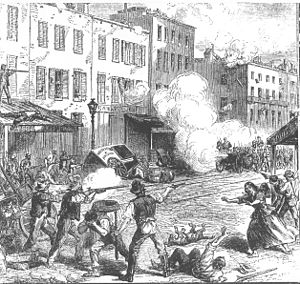
Then of course there’s class riots, and that arguably has been the main trend in riots for all of American history. Even if it seems to be buried under race and politics, believe me, if most of these rioters had a better standard of living, they would have stayed home. Even before our nation was officially founded, there are documented cases of workers and farmers revolting against their bosses or landlords up and down the East Coast. The most prominent of these types of riots was the New York City Draft Riots of 1863, which remain the deadliest riots in American history. This was in response to the draft that Congress initiated to replace massive Union losses in the Civil War. While it was at its core an initiative to stimulate volunteering, it was clumsily executed and enraged much of New York City’s population, which proved to be a cocktail of destruction: much of its industry was cotton based and connected to the South so they opposed the Civil War, and much of its workers were poor Irish immigrants who did not want to compete with black people for low-wage jobs, or rabid Nativists who didn’t want to compete with either of them. When a fire company’s chief was drafted, the firemen destroyed the local draft office and kicked off a city-wide revolt. For five days the city burned and both black people and Republicans were targeted by the rioters. It was finally put down with Federal troops fresh from the Battle of Gettysburg. 105 people were killed—eleven black people, eight soldiers, two policemen, and the rest rioters. Other than the Civil War itself, the riots remain the single-largest insurrection in American history.

Image result for nyc draft riots


And these are just events that can be solely classified as riots. They don’t account for the overwhelming amount of (mostly) peaceful protests (Vietnam, WWI) or the outright rebellions that occurred (Shays’ Rebellion, Southern secession). Along with riots, these reactions to authority show that American history is not a straight and clean line. It has many twists, turns, stutters, and splinters, but also progress. Whether a reaction is a protest, riot, or rebellion, if any of these events occur, authority is forced to take notice if they don't want their cities to burn.